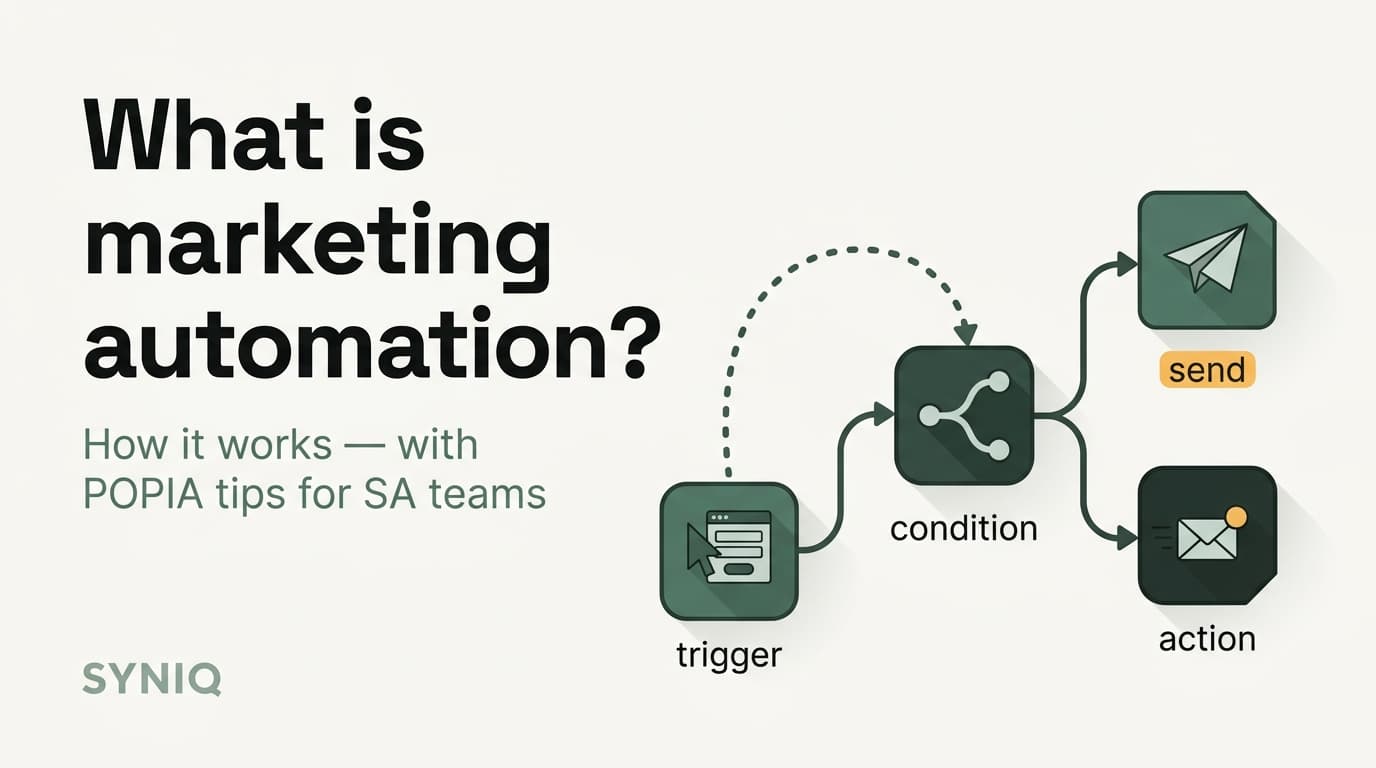
Marketing automation is software that runs repetitive marketing tasks — emails, follow-ups, lead scoring and social posts — automatically, triggered by what your customers do. You build a workflow once, and the system sends the right message to the right person at the right moment, then measures the result. In short, it turns marketing from a list of tasks someone has to remember into a system that runs on its own.
Every growing business hits the same wall: there are more leads, more customers, and more messages to send than there are hours to send them by hand. Follow-ups get forgotten, new subscribers wait days for a reply, and your best salesperson spends the morning copying names into a spreadsheet instead of closing deals. Marketing automation is how you break through that wall without hiring three more people. This guide explains what it is, exactly how it works, what you can automate, and how to keep it compliant with South Africa's POPIA rules.
What is marketing automation, in plain terms?
Think of marketing automation as a tireless assistant who never forgets a follow-up. You teach it your rules once — "when a new lead signs up, send this welcome email; three days later, if they haven't replied, send this one" — and it carries them out perfectly, every time, whether you have five new leads this week or five hundred.
Underneath, it is a platform that connects your customer data to your marketing actions. Instead of you manually tracking who did what and deciding who to contact next, the software watches customer behaviour across email, your website, SMS and social channels, and responds automatically according to the workflows you've set up. The repetitive work — sending, sorting, scoring, reminding — happens on its own. Your team keeps the parts that need a human: strategy, creativity, and real conversations.
Crucially, marketing automation is not spam. Done well, it makes your communication more relevant and better timed than manual marketing ever could — because it reacts to each customer individually rather than blasting everyone the same message on the same day.
How does marketing automation work?
At its heart, marketing automation runs on a simple three-part logic that repeats endlessly: trigger, condition, action. If you've ever set an "if this, then that" rule, you already understand the core idea.
1. A trigger starts the workflow. A trigger is something a customer does or a moment in time: filling in a form, clicking a link, visiting your pricing page, abandoning a cart, or simply a set number of days passing. The trigger is the "when."
2. A condition decides what happens next. The system checks what it knows about that person. Are they a new lead or an existing customer? Have they opened the last three emails or none? Which product did they look at? Conditions let one workflow branch into different paths for different people — this is the "if."
3. An action is carried out automatically. The platform does something: sends a personalised email or WhatsApp, adds the person to a segment, updates their record, notifies a salesperson, or waits before the next step. That's the "then."
String enough of these together and you get a workflow — an automated journey that can run for weeks, adapting to each person's behaviour along the way. The engine driving all of it is your customer data: the cleaner and more complete your data, the smarter the automation. That's why marketing automation and your customer database work best as one connected system, a point we'll come back to.
In 2026, this logic has grown smarter still. Leading platforms now layer AI on top of the rules — predicting which leads will convert, drafting email copy, and picking the best send time for each contact. Industry surveys put the share of marketers using AI tools in their day-to-day work at more than nine in ten.
What can you actually automate?
Almost any marketing task that follows a predictable pattern can be automated. These are the workflows South African businesses get the most value from:
| Workflow | Trigger | What the automation does |
|---|---|---|
| Welcome series | Someone subscribes or signs up | Sends a short email sequence that introduces your brand and points to the next step |
| Lead nurturing | A lead downloads a guide or visits key pages | Delivers relevant content over days or weeks to build trust before a sales conversation |
| Lead scoring & handoff | A lead crosses a score threshold | Alerts a salesperson and hands over a "warm", sales-ready lead |
| Abandoned cart or quote | A checkout or quote is left unfinished | Sends timed reminders to recover the sale |
| Post-purchase | An order is placed or an invoice is paid | Confirms the order, onboards the customer, and suggests a relevant next product |
| Win-back | A customer goes quiet for a set period | Re-engages them with a check-in or a tailored offer |
Two of these deserve a closer look because they're where the money is.
Lead nurturing means staying useful to a prospect who isn't ready to buy yet. Instead of "are you ready to buy?" emails, an automated sequence sends genuinely helpful content — a how-to, a case study, an answer to a common objection — spaced out over time, so by the time they're ready, you're the business they trust.
Lead scoring solves a problem every sales team has: which leads deserve attention right now? The system awards points for meaningful actions — a pricing-page visit might be worth 20 points, an email open 5, a guide download 10 — and when someone crosses your threshold, it flags them for a human to call. Your salespeople stop guessing and focus on the people most likely to buy.
Marketing automation vs email marketing vs a CRM: what's the difference?
These three tools are constantly confused, and the confusion leads to expensive mistakes. Here's the clean distinction:
| Email marketing | Marketing automation | CRM | |
|---|---|---|---|
| What it is | A tool for sending emails to a list | Software that runs multi-step, behaviour-triggered journeys across channels | The system of record for customer relationships |
| Main job | Send one message to many people | Send the right message automatically based on what each person does | Store and manage every contact, deal and conversation |
| Started by | You, manually, per send | Customer behaviour and your rules | Human updates and integrations |
| Best for | Newsletters and once-off announcements | Nurturing, onboarding and retention at scale | Sales tracking and a single customer view |
The short version: email marketing is one channel, a CRM is your memory, and marketing automation is the engine that connects behaviour to action across everything. They're strongest together — the automation reads from and writes to the CRM, and email is simply one of the channels it uses. If you're weighing up the underlying customer database, our guide on how to choose a CRM for a small business in South Africa is a good companion read.
Tired of doing marketing by hand? Syniq's Business OS builds marketing automation, Sales & CRM, and support onto one shared database — so your leads, follow-ups and customer records finally live in the same place. Book a no-obligation discovery call and we'll map it to your business.
What are the benefits of marketing automation?
The headline benefit is leverage: a small team acting like a much bigger one. But it's worth breaking down where the value actually comes from.
It gives you back time. The hours spent sending, sorting and reminding disappear into workflows that run themselves, freeing your team for work that genuinely needs a person.
It makes follow-up reliable. Automation never forgets and never gets busy. Every lead gets the follow-up you designed, on schedule, whether it's a quiet Tuesday or your busiest month.
It personalises at scale. Because the system reacts to each person's behaviour, thousands of customers can each receive a relevant, well-timed message — something no team could do by hand.
It pays for itself. Adoption is now mainstream precisely because the return is real: roughly three-quarters of businesses already use some form of marketing automation, and the majority report a positive return within the first year. Triggered, behaviour-based messages consistently outperform once-off batch sends, because they reach people at the moment they're actually paying attention.
It shows you what's working. Every workflow is measured, so you can see which journey converts and which email gets ignored — and improve with evidence instead of guesswork. That visibility compounds when your marketing data sits alongside your sales and finance data, which is the whole idea behind a business operating system.
Does marketing automation work for small businesses?
Yes — and arguably it matters more for a small business than a large one, because you have fewer hands to spare. The old assumption that automation is only for big companies with big budgets is out of date; small and medium enterprises are now the fastest-growing group of adopters, largely thanks to affordable, plug-and-play tools.
The key is to start small. You don't need a twelve-step, AI-driven mega-funnel on day one. Pick the single workflow that would save you the most pain right now — usually a welcome series for new leads, or an automated follow-up so quotes never go cold — get it working, and build from there. One reliable automation that runs every day beats an elaborate system that's too complex to maintain.
Marketing automation and POPIA: how to stay compliant
This is the part global "marketing automation 101" articles skip, and it's the part that matters most in South Africa. Automated marketing means sending electronic communications, and those are governed by the Protection of Personal Information Act (POPIA).
Under Section 69 of POPIA, direct marketing by electronic means — email, SMS, automated calls — to someone who is not already your customer is only allowed if that person has consented (opted in). You may approach a person once to ask for that consent, and every message thereafter must give them a free, easy way to opt out.
There is an important exception for existing customers: if you obtained someone's details during a sale, you may market your own similar products to them, provided you gave them a clear chance to object at collection and in every message since. On top of this, South Africa's move toward a national opt-out registry means honouring unsubscribe requests is not optional housekeeping — it's a legal duty, with penalties for getting it wrong.
The practical takeaways for any automated workflow: collect explicit opt-in consent and record it, put a working unsubscribe link in every message, and stop the moment someone objects. A well-built platform makes this easier — it logs consent, suppresses opted-out contacts automatically, and keeps the audit trail you'd need if the Information Regulator ever asked. For the bigger picture, see our plain-English POPIA overview. None of this is legal advice — check your specific setup with a professional — but building consent into your workflows from day one saves a great deal of trouble later.
How do you get started with marketing automation?
You don't need to boil the ocean. A sensible rollout looks like this:
- Tidy your data first. Automation is only as good as the customer data feeding it. A clean, single list beats three messy ones. (Poor data quality is the single most common thing that holds automation back.)
- Map one customer journey. Choose the highest-value moment — a new lead, an abandoned quote, a recent purchase — and sketch what should happen at each step.
- Pick one trigger and build one workflow. Start with a welcome series or a follow-up sequence. Keep it simple enough to launch this month.
- Measure, then expand. Watch how it performs, refine it, and only then add the next workflow.
The bigger strategic choice is buy versus build. Most South African businesses are best served by an all-in-one platform where marketing automation shares a database with sales, invoicing and support — a won lead flows straight into the pipeline and on to an invoice with nothing re-keyed. That's the "buy" path we designed Business OS around, and you can see transparent local pricing on the Business OS pricing page; the Sales & CRM module is where automated lead scoring hands warm leads to your team. If your process is genuinely unusual — or automation is core to the product you sell — a custom-built solution shapes itself to exactly how you work, built by an in-house Cape Town team with POPIA-grade security.
Ready to let your marketing run itself? Whether you want an all-in-one platform or a bespoke build, Syniq will help you automate the right things in the right order. Book your free discovery call — no obligation, just a clear next step.
Frequently asked questions
What is marketing automation in simple terms? It's software that does repetitive marketing tasks for you automatically — like sending a welcome email when someone signs up, or reminding a shopper who left items in their cart. You set up the rules once, and the system carries them out for every customer, at the right moment, without anyone lifting a finger.
What is the difference between marketing automation and email marketing? Email marketing sends one message to a list when you press send. Marketing automation is broader: it runs multi-step journeys across email, SMS and other channels, triggered automatically by what each person does. Email is a single channel; marketing automation is the engine that decides what to send, to whom, and when.
Do I need a CRM to use marketing automation? Not strictly, but they work far better together. Your CRM holds the customer data — contacts, deals, history — that makes automation smart and personalised. Many businesses choose a platform where the CRM and marketing automation share one database, so the two are always in sync rather than passing data back and forth.
Is marketing automation worth it for a small business in South Africa? For most small businesses, yes. It's often the difference between following up with every lead and letting half of them go cold. Small and medium businesses are the fastest-growing adopters precisely because affordable tools now deliver a strong return. Start with one workflow that saves you real time, then expand.
Is automated email marketing legal under POPIA? Yes, if you follow the rules. Under Section 69 of POPIA, you generally need a person's opt-in consent before sending electronic direct marketing, unless they're an existing customer and you're marketing similar products. Every message must include an easy way to opt out, and you must stop when someone objects. Build consent and unsubscribe handling into your workflows from the start.
How long does it take to set up marketing automation? A single workflow — a welcome series or a follow-up sequence — can be live within days. The variable that takes longer is cleaning and organising your customer data. A connected platform or a custom build takes more setup but does more; the smartest approach is to launch one simple automation quickly, prove the value, and grow from there.