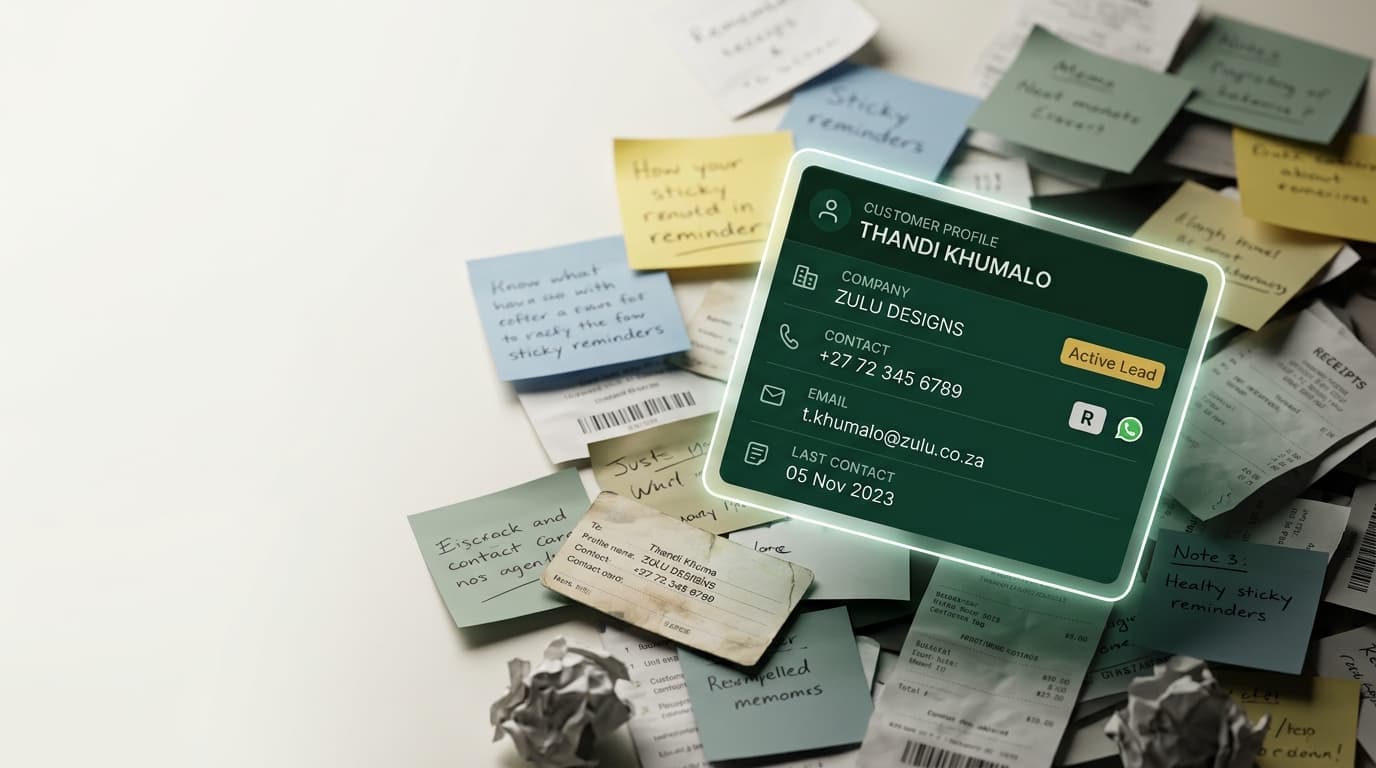
To choose a CRM for a small business in South Africa, define your sales process first, then shortlist tools that offer POPIA compliance, native WhatsApp, Rand-friendly pricing, and accounting integration. Trial two or three options with real leads, and pick the simplest system your team will actually use every day. The best CRM is rarely the one with the most features — it's the one your salespeople open every morning without being asked.
Most South African small businesses don't lose deals because their product is weak. They lose them because a quote sat unanswered in an inbox, a follow-up never happened, or the one person who knew the client moved on. A CRM (Customer Relationship Management system) closes those gaps by giving every customer a single, shared record. This guide covers when you need one, the features that genuinely matter in the South African market, what it costs in Rands, and a simple framework for making the call with confidence.
What is a CRM, and does your small business need one?
A CRM is the system of record for every customer relationship — contacts, conversations, quotes, deals, and history — held in one place your whole team can see. Instead of customer detail living in WhatsApp threads, a sales rep's memory, and three different spreadsheets, it lives in one searchable hub that doesn't walk out the door when someone resigns.
You probably need a CRM if any of these sound familiar: leads slip through because nobody followed up in time; you can't say how many deals are in your pipeline right now; monthly reporting means rebuilding a spreadsheet from scratch; or losing a staff member means losing their client knowledge. If that pain feels familiar, our guide on the signs your business has outgrown spreadsheets breaks down the warning signs in detail.
One clarification worth making early: a CRM is not an ERP. A CRM manages the front office — sales, marketing, and service. An ERP manages the back office — finance, inventory, and operations. If you're not sure which problem you're solving, read our breakdown of CRM vs ERP for South African businesses before you spend a cent.
When is the right time to get a CRM?
The honest answer is: slightly before you think you need one. The clear signals are more than a handful of active leads at once, two or more people touching the same customers, a sales cycle long enough that follow-up timing changes the outcome, or a founder who has quietly become the bottleneck because every relationship runs through them.
Timing matters for a practical reason: migration. Setting up a CRM while you have 200 contacts is a weekend job. Migrating 20,000 contacts and years of messy history later is a project. Earlier is almost always cheaper than later.
What features should a South African small business look for in a CRM?
This is where local context separates a good fit from an expensive mistake. A CRM built for the US or Europe can look impressive in a demo and still miss the things that matter most here. Prioritise the following.
POPIA compliance and data residency. Any system holding customer names, numbers, or emails must meet the Protection of Personal Information Act's eight conditions for lawful processing. In practice that means encryption of data both at rest and in transit, clear rights for customers to access, correct, or delete their information, and an appointed Information Officer registered with the Information Regulator. If a tool stores South African customer data on overseas servers, that's a cross-border transfer needing a legal basis under Section 72 of the Act. Penalties for getting it wrong reach up to R10 million, and enforcement is tightening. Start with our plain-English POPIA overview.
Native WhatsApp. WhatsApp is the default communication layer in South Africa — adoption sits at roughly 96% of internet users, and the country is on track for around 28 million users in 2026. If your customers talk to you on WhatsApp but those conversations never reach your CRM, your "single customer record" has a hole in the middle of it. Native WhatsApp integration is close to non-negotiable for local SMEs.
Rand-friendly pricing. Most global CRMs bill in US dollars. At roughly R16.40 to the dollar in mid-2026, a "$15 per user" plan is about R246 — but that figure moves every time the rand wobbles, making budgeting unpredictable. A tool priced in Rands, or a local provider, removes that exchange-rate exposure entirely.
Accounting and tool integration. Many South African small businesses keep their books in Sage or a similar package. If your CRM can't pass a won deal through to an invoice, someone re-keys it by hand and errors creep in. Look for accounting integration, or consider a platform where sales and finance already share one database — here's why some teams choose a connected alternative to Sage.
Resilience for local conditions. Load shedding and patchy connectivity are facts of life. A CRM with a strong mobile app, offline access, or reliable reconnection beats a purely real-time tool that stalls the moment the power or signal drops.
Simplicity and adoption. The most common reason CRM projects fail is that nobody uses the thing. If a tool needs a paid consultant just to switch on, that's a warning sign for a small team. Favour systems your staff can learn in an afternoon.
Core capabilities, with room to grow. The non-negotiable basics are a single contact record, a visual pipeline, task and follow-up reminders, and reporting you can read at a glance. Then confirm it scales — that you can add users, automation, and features as you grow without ripping the system out and starting over.
Want a CRM that's already POPIA-aware, WhatsApp-ready, and priced in Rands? Syniq's Business OS Sales & CRM is built for South African teams. Book a no-obligation discovery call and we'll map it to your exact sales process.
How much does a CRM cost in South Africa?
CRM pricing is usually charged per user, per month, and climbs as you add automation, reporting, and support. Because most international tools bill in US dollars, the figures below are indicative ranges converted at roughly R16.40/USD (June 2026) — your actual Rand cost shifts with the exchange rate.
| Tier | Typical USD / user / month | Indicative ZAR / user / month | Best for |
|---|---|---|---|
| Free / starter | $0–$7 | R0–R115 | Solo operators and very small teams testing the water |
| Entry | $8–$15 | ~R130–R250 | Small teams needing contacts plus a pipeline |
| Growth / mid-tier | $30–$65 | ~R500–R1,070 | Growing teams adding automation and reporting |
| Enterprise | $150+ | ~R2,460+ | Larger teams needing advanced control and customisation |
The sticker price is only part of the story. Budget for the hidden costs too: data migration, setup or consulting, paid add-on integrations, and training. For a team of five on a growth-tier plan, the realistic total is the monthly subscription plus a once-off onboarding effort. A locally built, all-in-one platform can work out cheaper than stitching several point tools together — you can see transparent local pricing on the Business OS pricing page. For a fixed quote matched to your team size and workflow, book a scoping call.
Should you buy a standalone CRM or an all-in-one platform?
There are three broad paths, and the right one depends on how much of your business you want connected.
1. A standalone CRM. Quick to start and tightly focused on sales. The trade-off is that it only handles sales — you'll still need separate tools for invoicing, marketing, and support, and you'll pay to integrate them or copy data between them by hand.
2. An all-in-one business platform. A CRM that shares one database with operations, marketing, finance, and support. A won deal becomes an invoice automatically, and an executive dashboard shows the whole business at once. This is the "buy" path we built Business OS for — Sales & CRM, operations, marketing, tax-compliant invoicing, and support in one place, aimed at South African SMEs and agencies.
3. A custom build. If your sales process is genuinely unusual, or a CRM is core to the product you sell, bespoke software fits your workflow exactly instead of forcing you into someone else's. That's the "build" path: our custom software team designs around how you actually work, with an in-house Cape Town team and POPIA-grade security.
| If you... | Best fit |
|---|---|
| Just need a sales pipeline and nothing else | Standalone CRM |
| Want sales, finance, marketing, and support connected | All-in-one platform (Business OS) |
| Have a unique process, or CRM-as-product | Custom build |
How to choose a CRM: a simple framework
- Write down your real sales process — the actual steps a lead takes from first contact to paid invoice. Your CRM must mirror this, not the other way around.
- Split must-haves from nice-to-haves. For South African teams, POPIA compliance, WhatsApp, and accounting integration usually belong firmly in the must-have column.
- Shortlist two or three tools that fit your process and budget — no more, or you'll never decide.
- Run a real trial using live leads, not dummy data, for about two weeks.
- Judge adoption, not features. Did your team use it without being nagged? That's the only score that matters.
- Confirm your exit. Can you export all your data if you ever leave? If the answer isn't a clear yes, walk away.
Common mistakes to avoid
A few patterns quietly undermine CRM investments: buying for impressive features you'll never use; choosing on headline price alone while ignoring exchange-rate risk on dollar-billed tools; treating POPIA as an afterthought until a breach forces the conversation; and rolling out with no training, then blaming the software when adoption stalls. Each is avoidable with a little planning up front.
The bottom line
A good CRM makes your team faster and your customers better looked after — it should remove admin, not add it. Define your process, insist on POPIA compliance and WhatsApp, keep one eye on Rand pricing, and choose the simplest tool people will genuinely use. Get those four right and the brand on the box matters far less than you'd think.
Ready to put every customer in one place? Syniq's Business OS Sales & CRM gives South African small businesses a CRM that's POPIA-aware, WhatsApp-ready, and connected to the rest of the business. Book your free discovery call — no obligation, just a clear next step.
Frequently asked questions
Does a small business really need a CRM, or is a spreadsheet enough? A spreadsheet works until two people need to update it at once, or you start losing track of follow-ups. A CRM adds shared access, automatic reminders, and pipeline visibility a spreadsheet can't — usually worth it once you have more than a handful of active leads or more than one person selling.
What makes a CRM POPIA compliant? POPIA compliance comes from how you use the tool plus what the tool enables: lawful, purpose-limited processing, encryption in transit and at rest, a legal basis for any cross-border data transfer, an appointed Information Officer, and the ability to action customer access, correction, and deletion requests. Non-compliance can carry fines of up to R10 million.
How much does a CRM cost for a small business in South Africa? Indicatively, free to around R250 per user per month for entry tiers, and roughly R500–R1,070 for growth tiers, converted at mid-2026 exchange rates. Dollar-billed tools move with the rand, and setup, migration, and training add to the total. Book a scoping call for a fixed quote.
Which is better for a small business: Zoho, HubSpot, Pipedrive, or Salesforce? Each suits different needs — lighter tools favour simple pipelines, heavier ones favour large teams with complex requirements. Rather than chase a brand, match the tool to your sales process and your local must-haves (POPIA, WhatsApp, Rand pricing). The best CRM is the one your team will actually open every day.
Can I get a CRM that includes invoicing and support too? Yes. An all-in-one platform such as Syniq's Business OS combines CRM with operations, marketing, tax-compliant invoicing, and support, so a won deal flows straight through to an invoice without anyone re-keying it.
How long does it take to set up a CRM? A simple standalone CRM can be live in a few days. A connected platform or a custom build takes longer but does more. The bigger variable is usually data migration and team training — budget realistic time for both, because a half-loaded CRM nobody trusts is worse than none.
Ready to put every customer in one place?
A good CRM should make selling feel lighter, not heavier. Define your sales process, insist on POPIA compliance, WhatsApp, and Rand pricing, and choose the simplest tool your team will actually use. If you'd like that decision made with someone who knows the South African market, book a no-obligation discovery call — or explore Syniq Business OS to see a CRM that's already connected to the rest of your business.