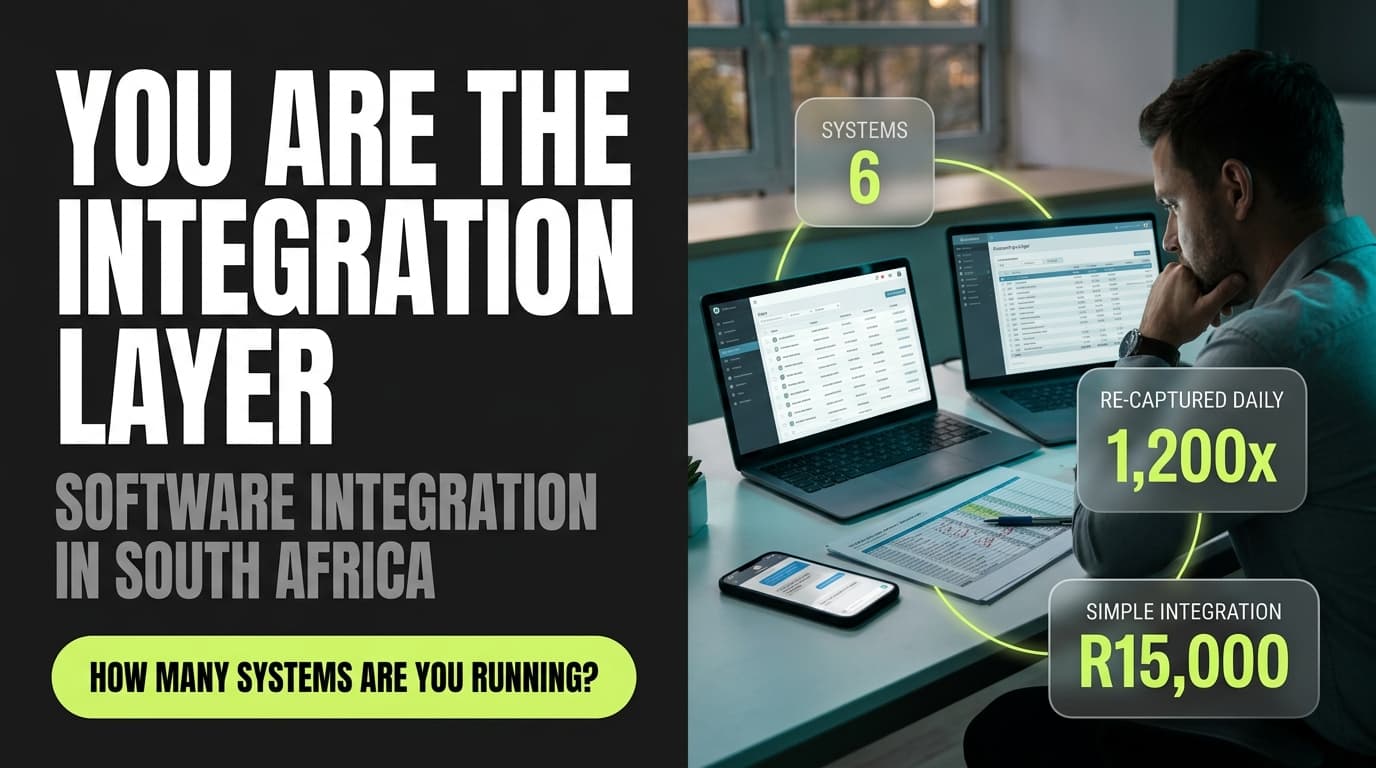
Software integration is the work of making separate business systems share data automatically, so a customer captured once appears everywhere it is needed. South African businesses typically choose between native connectors, an automation platform from around R150 a month, custom API integration scoped per project, or consolidating onto a single operations platform.
Every growing business reaches the same afternoon. Someone asks a simple question — how much did we actually invoice that client this year — and answering it takes forty minutes, three logins and a spreadsheet nobody trusts.
The tools are not the problem. Each one does its job. The problem is the space between them, and the person who has become the integration layer.
What is software integration?
Software integration is the practice of connecting separate applications so that data moves between them without a human retyping it.
Think of your business systems as buildings on a campus. Each is well built. But if there are no walkways, every delivery between them happens on foot, in the rain, carried by whoever is available. Integration is the walkways. It does not change what the buildings do — it changes how much energy the campus burns getting anything from one to another.
That energy is measurable. Researchers who tracked 137 people across three Fortune 500 companies found workers toggled between applications roughly 1,200 times a day, spending just under four hours a week simply reorienting themselves after each switch — about 9% of their working time. Fewer walkways, more walking. We have written separately about what that fragmentation costs a South African business.
What are the four ways to integrate business software?
There are four, and most businesses eventually use a mix.
1. Native connectors. The integration your vendors already built. Your accounting package has a Shopify connector; your CRM has a mailbox sync. Free or bundled, fast to switch on, and limited to whatever the vendor decided to support.
2. An automation platform (iPaaS). Tools like Zapier or Make sit between your apps and move data on triggers: when a deal is marked won, create the invoice. No code, priced per action, and excellent for the connections your vendors ignored.
3. Custom API integration. Purpose-built code that talks directly to each system's API. This is what you use when the logic is genuinely yours — conditional routing, multi-step reconciliation, anything with real business rules inside it. Most serious South African business software exposes an API for exactly this: Sage Business Cloud Accounting, for instance, publishes a RESTful JSON API that developers access with an issued API key. If the term is new, start with our plain-language explainer on what an API actually is.
4. Consolidation. Replace several tools with one platform where the modules already share a database. The integration you do not have to build is the only one that never breaks.
| Approach | Setup effort | Ongoing cost | Handles complex rules | You maintain it |
|---|---|---|---|---|
| Native connector | Minutes | Usually free | Poorly | No — vendor does |
| Automation platform | Hours to days | Per task or credit | Moderately | Yes, lightly |
| Custom API integration | Weeks | Hosting plus support | Exactly | Yes, or your partner does |
| Consolidation onto one platform | Days to weeks | Per seat | Natively | No |
How much does software integration cost in South Africa?
Two very different cost structures, so treat them separately. Dollar prices below convert at roughly R16.50 to the dollar — during August 2026 the rand traded in a band of about R16.07 to R16.98 — and exclude VAT.
Automation platforms are subscriptions, priced by volume rather than by connection:
| Tier | Typical published price | Indicative monthly cost (ZAR) | Realistic use |
|---|---|---|---|
| Free tier | $0 | R0 | One or two low-volume workflows |
| Entry paid tier | ~$9–$16 / month | ~R150–R265 | A handful of automations, one operator |
| Professional tier | ~$20–$30 / month | ~R330–R495 | Several business-critical workflows |
| Team tier | ~$29–$103 / month | ~R480–R1,700 | Multiple users sharing and editing workflows |
Watch the billing unit rather than the headline price. These platforms charge per action executed, not per automation built — a five-step workflow that runs a hundred times a month consumes five hundred units, not a hundred. A workflow that looks cheap in a demo can quietly become your most expensive subscription at real volume.
Custom integration is a project, priced in hours. Published South African agency rates run roughly R450 to R1,200 an hour, with Cape Town senior work at the upper end. Applying that arithmetic:
| Integration type | Indicative effort | Indicative cost (ZAR) |
|---|---|---|
| One-way, single object (e.g. push new customers to accounting) | 20–40 hours | ~R15,000–R40,000 |
| Two-way sync with conflict handling | 60–120 hours | ~R45,000–R120,000 |
| Multi-system workflow with business rules and reporting | 150+ hours | Scoped per project |
These are indicative ranges to help you budget, not a quote. Real cost depends on API quality, data volume, how clean your existing records are, and how much reconciliation logic the business actually needs. Book a no-obligation discovery call and we will scope a fixed price against your systems.
One line item almost everyone forgets: maintenance. APIs change, credentials expire, vendors deprecate endpoints. Budget for someone to own each integration after launch, or it will fail silently at the worst possible moment.
Which systems should you integrate first?
Sequence by where money and time leak, not by what is technically interesting. In practice the order is nearly always this:
- Sales to finance. A won deal should become an invoice without anyone retyping a line item. This is the highest-value connection in almost every business, because errors here cost revenue directly. Syniq's Sales and CRM and Finance modules share one record set precisely so this handoff has no seam.
- Payments to accounting. Reconciliation is pure administrative overhead. Automating it returns hours every month and makes your cash position honest between month-ends.
- Support to customer record. Your salesperson should know the client logged three tickets last week before they phone about a renewal.
- Everything to reporting. Once the first three are flowing, a live executive dashboard becomes possible — and reflects reality rather than last month's export.
Resist the temptation to connect everything at once. Integrate one chain, run it for a month, confirm it holds. Then the next.
Does POPIA apply when data moves between systems?
Yes, and this is where integration projects most often skip a step.
The moment personal information leaves one system for another, three obligations attach. Under section 19 of the Protection of Personal Information Act you must secure the integrity and confidentiality of that data — which includes it in transit, not just at rest. Under section 21, if a third party processes personal information on your behalf, you need a written operator contract requiring them to maintain those same safeguards and to notify you immediately of any unauthorised access. And under section 22, a breach at that operator is still your notification duty to the Information Regulator and affected data subjects.
Two practical consequences for anyone wiring systems together:
Your automation platform is an operator. If a no-code tool passes customer names, ID numbers or contact details between your apps, it is processing personal information on your behalf. Check that a compliant operator agreement or data processing addendum is in place, and know which country the data passes through.
Integrate the minimum. The instinct is to sync every field because you can. Data minimisation says otherwise: move only what the receiving system genuinely needs. Fewer fields crossing fewer boundaries is both cheaper to build and easier to defend. You can read how we approach this on our POPIA page.
This is general information, not legal advice. Confirm your specific obligations with a qualified advisor.
Should you integrate your tools or replace them?
At some point the honest question stops being "how do we connect these?" and becomes "why do we have these?"
Integration has a compounding cost. Each connection is a small system in its own right, with its own failure modes and its own maintenance. Six tools can be wired together fifteen different ways. The web does not grow linearly — it grows like a knot.
Integrate when your tools are genuinely best-in-class for what they do, when your team knows them well, and when the connections you need are few and stable.
Consolidate when you are paying for overlapping functionality across several subscriptions, when nobody can say confidently which system holds the true version of a customer, or when the integrations themselves have become a line item you notice. Business OS puts sales, operations, marketing, finance, support and reporting on one data model — not connected, but the same, and it still talks to the tools you keep. Where your operation is genuinely unusual, our custom software team builds the system around your process instead of the other way around, in-house in Cape Town with weekly demos.
The test is simple. Count the number of places a customer's details currently live. If the answer is more than two, you are already paying for integration — you are just paying for it in someone's afternoon.
A practical starting checklist
Before you brief anyone, do this:
- List every system that holds customer or financial data. Include the spreadsheets. Especially the spreadsheets.
- Draw the handoffs. Who moves what, from where, to where, and how often. On paper is fine.
- Mark the manual ones. Those are your integration candidates, ranked by hours consumed.
- Check the APIs exist. A system without an accessible API constrains every option except replacement.
- Decide who owns each connection after launch. No owner means no integration, eventually.
The bottom line
If your team is re-capturing the same data across three systems, you already know what it costs. The question is only which fix is cheapest over three years — connecting what you have, or consolidating onto something that was never separate.
Ready to stop being the integration layer? Book a no-obligation discovery call. Bring your list of systems and your handoff map. We will tell you honestly which of the four paths fits, and what it would take.
Frequently asked questions
What is software integration? Software integration is the work of connecting separate business applications so data moves between them automatically. Instead of a person copying a new customer from your CRM into your accounting system, the systems exchange that record themselves — through a native connector, an automation platform, or a custom API integration.
How much does software integration cost in South Africa? Automation platforms start free and typically run about R150 to R1,700 a month depending on volume and users. Custom integrations are priced by effort: at published South African agency rates of roughly R450 to R1,200 an hour, a simple one-way integration lands around R15,000 to R40,000, while a two-way sync with conflict handling is closer to R45,000 to R120,000. All figures are indicative — get a scoped fixed quote.
What is the difference between an API and an integration? An API is the doorway a system exposes so other software can read or write its data. An integration is what you build through that doorway. Two systems can both have excellent APIs and still not be integrated — the API is the capability, the integration is the connection.
Do I need a developer to integrate my business software? Not always. Native connectors and no-code automation platforms handle straightforward, low-volume connections without any code. You need a developer when the logic involves real business rules, when volumes make per-action pricing expensive, or when a system's API requires authentication and error handling that no-code tools cannot manage reliably.
Does POPIA apply to data moving between my systems? Yes. Section 19 requires you to secure personal information, including while it is in transit. If a third-party tool processes that data on your behalf it is an operator, and section 21 requires a written contract obliging it to maintain those safeguards and report unauthorised access immediately. A breach at your operator remains your notification duty.
Is it better to integrate my existing tools or move to one platform? Integrate when each tool is genuinely best at its job and the connections you need are few and stable. Consolidate when you are paying for overlapping features, when no one can say which system holds the true customer record, or when maintaining the connections has become its own workload. Integration cost compounds with every tool you add.
Written by Mikhail for Syniq (Pty) Ltd. Syniq is a Cape Town software company building Business OS and custom software for growing South African businesses. This article is general guidance, not legal advice — confirm your own POPIA obligations with a qualified advisor. Pricing is indicative for August 2026 and moves with vendor changes and the exchange rate.