Booking software lets customers reserve a time with your business online, then handles the reminders, payments and calendar admin automatically. In South Africa, standalone tools typically run from free to around R1,000 per month, while an integrated or custom booking system starts higher but removes the manual re-capturing that eats service businesses alive.
Most South African service businesses do not lose money on the booking itself. They lose it in the gaps around the booking — the WhatsApp thread that never became a diary entry, the double-booked Saturday, the client who forgot, the invoice raised three days late because the job sheet was on someone's phone.
A booking system is the piece of software that closes those gaps. Here is how to choose one.
What is booking and scheduling software?
Booking and scheduling software is a tool that publishes your availability, takes reservations from customers without a phone call, and then automates everything that follows: confirmations, reminders, rescheduling, deposits, and the record of what happened.
Think of it as a receptionist who never sleeps, never double-books, and writes everything down. The good ones do four jobs:
- Show real availability — synced to your team's actual calendars, not a guess.
- Take the booking — on a web page, a WhatsApp link, or inside your app.
- Reduce no-shows — automated reminders and, where appropriate, deposits.
- Hand off cleanly — the booking becomes a job, an invoice, and a data point, without anyone retyping it.
Job four is where most businesses get stuck. A tool that only does jobs one to three is a calendar with a nice front door.
How much does booking software cost in South Africa?
Most international tools price in dollars or euros, so your rand cost moves with the exchange rate. The ranges below convert at roughly R16.50 to the dollar, which sits inside the August 2026 band, and exclude VAT.
| Approach | Typical pricing model | Indicative monthly cost (ZAR) | Best suited to |
|---|---|---|---|
| Free tier of a scheduling tool | Free, feature-capped | R0 | Solo operators, one calendar, no payments |
| Per-user scheduling tool | ~$10–$16 per user / month | ~R165–R265 per user | Consultants and small teams booking meetings |
| Per-account booking platform | ~$20–$61 per account / month | ~R330–R1,010 | Clinics, salons, studios with multiple staff |
| Commission-based platform | % of each transaction (~1–3% plus a fixed fee) | Varies with turnover | High-volume walk-in businesses |
| Booking inside an operations platform | Per-seat, bundled with CRM, invoicing, support | See Business OS pricing | Businesses that want one system, not six |
| Custom-built booking system | Once-off build plus hosting and support | Scoped per project | Unusual rules, regulated data, or booking as a competitive advantage |
Two costs are almost always missing from the sticker price.
Transaction fees. If customers pay a deposit online, your local payment gateway takes a percentage on top of the software subscription.
Messaging. Automated SMS and WhatsApp reminders are billed per message by the network or provider. At meaningful volumes this can quietly exceed the software subscription itself. Budget for it deliberately rather than discovering it on an invoice.
Every figure above is indicative. Pricing depends on your team size, volume and integrations — book a no-obligation discovery call and we will scope a fixed quote against your actual numbers.
What features actually matter for South African businesses?
International feature lists are written for international markets. These are the ones that change the answer locally.
WhatsApp as a first-class channel
South Africans book, confirm and reschedule on WhatsApp. A booking system that only sends email reminders is sending into a channel your customers may not check the same day. Reminder research is unambiguous on the value of the right channel: studies of appointment reminders consistently report double-digit reductions in non-attendance, with SMS reminders cutting missed appointments by roughly 29–39% compared with no reminder at all. Businesses running no reminder system at all commonly sit at 20–30% no-shows.
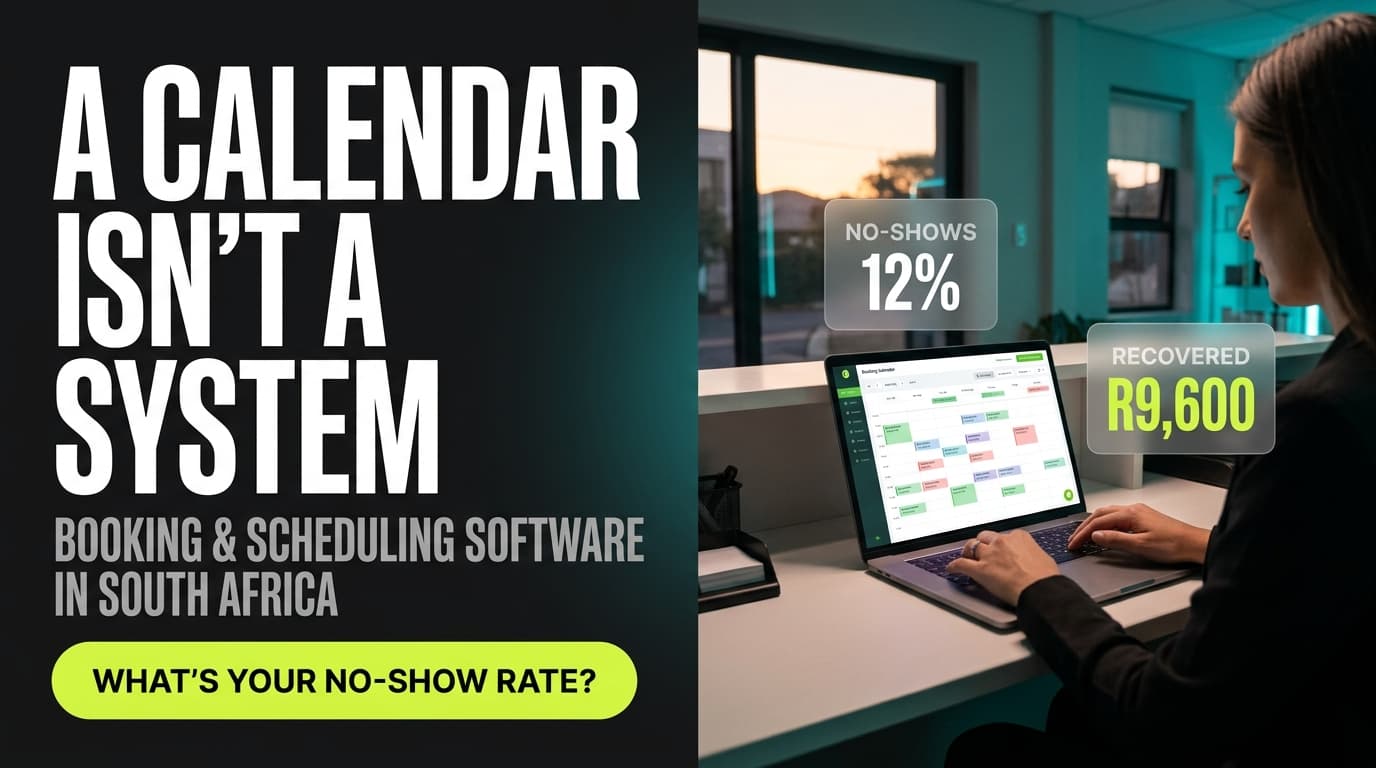
Run the arithmetic on your own diary. If you take 200 bookings a month at R600 each and reminders move your no-show rate from 20% to 12%, that is roughly R9,600 of recovered revenue a month — before you have counted the rebooking admin you no longer do.
Local payment gateways
Deposits are the second lever on no-shows. That only works if checkout feels normal to a South African customer: a gateway that supports local cards, EFT and instant-EFT options, settles into a local bank account, and prices in rand. Verify the specific gateways a tool supports before you commit, not after.
Tax-compliant invoicing on the other side
A booking that becomes a job should become a valid tax invoice without anyone retyping it. If you are VAT-registered, the invoice must carry the fields SARS requires. Systems that treat invoicing as an afterthought push that work back onto a person — which is exactly the manual step you were trying to remove. Syniq's Finance and Accounting module closes that loop inside the same platform.
Load-shedding and connectivity tolerance
Your team will sometimes be on a phone, on mobile data, in a building with no power. A booking system that only works on a stable desktop connection will be worked around, and a system that is worked around stops being the source of truth. Mobile-first behaviour and graceful handling of dropped connections are practical requirements here, not luxuries.
Multi-location and multi-resource rules
Booking a person is easy. Booking a person and a room and a machine, across two branches, with different operating hours, is where most off-the-shelf tools start bending. Write your real rules down before you shortlist anything.
Does a booking system need to be POPIA compliant?
Yes. A booking system collects names, contact details and often the reason for the appointment, which makes you a responsible party under the Protection of Personal Information Act.
Two obligations matter most in practice. You must collect only what you actually need for the booking, and you must be able to tell a customer what you hold and delete it on a valid request. Both are far easier when bookings live in one system than when they are scattered across a spreadsheet, an inbox and three WhatsApp threads.
The stakes rise sharply if your appointments touch health. POPIA classifies health information as special personal information, and the Information Regulator published the Regulations Relating to the Processing of Data Subjects' Health Information by Certain Responsible Parties, 2026 in Government Gazette No. 54268 on 6 March 2026, in force from that date. The regulations set out explicit expectations around lawful processing, security safeguards and cross-border transfers for defined categories of responsible party. If your booking form captures anything about a client's physical or mental health — even a free-text "reason for visit" — take proper advice on where that data is stored and who can reach it.
That last point deserves emphasis: many international booking tools host data offshore by default. That is not automatically non-compliant, but it is a decision you should make knowingly rather than inherit. You can read how Syniq approaches this on our POPIA page.
This is general information, not legal advice. Confirm your specific obligations with a qualified advisor.
Should you buy a booking tool or build a custom one?
| Off-the-shelf booking tool | Booking inside an operations platform | Custom-built system | |
|---|---|---|---|
| Time to live | Days | Days to weeks | Weeks to months |
| Upfront cost | Low | Low | Higher |
| Ongoing cost | Per user or per transaction | Per seat, bundled | Hosting plus support |
| Fits unusual rules | Poorly | Reasonably | Exactly |
| Connects to CRM, invoicing, reporting | Via integrations you maintain | Natively | However you design it |
| Data location control | Limited | Defined | Full |
| Best when | Booking is simple and standalone | You want one operational system | Booking is the product or the rules are genuinely unique |
The honest guidance: if your booking rules look like everybody else's, buy. Paying a subscription for a solved problem is good business.
Build when one of three things is true. Your scheduling logic is genuinely unusual and you have already watched two tools fail at it. Your booking data is sensitive enough that you need control over where it lives and who touches it. Or the booking experience is the thing customers choose you for, in which case renting it from a platform is renting your differentiator. Our custom software team builds these in-house in Cape Town, with weekly demos so you see the system take shape rather than waiting for a reveal.
How does booking connect to the rest of your business?
This is the question that separates a tool from a system.
A booking is not an end state. It is the beginning of a chain: enquiry → booking → job → invoice → payment → follow-up → repeat business. Every handoff in that chain that a human performs manually is a place where revenue leaks and time disappears.
When booking lives inside your operations platform, the chain runs itself. The booking creates the customer record in Sales and CRM. Completion triggers the invoice. Payment updates the executive dashboard. Follow-up campaigns fire on schedule. Nobody retypes anything, and your reporting reflects reality because there is only one version of it.
When booking sits in its own silo, you get an accurate calendar and an inaccurate business. That trade-off is affordable at five bookings a week. It is expensive at fifty.
How to choose: a practical shortlist
Work through this before you compare a single price.
- Write your rules first. Staff, rooms, equipment, buffers, travel time, cancellation windows, deposits. Rules first, then tools.
- Count your monthly bookings and your no-show rate. These two numbers decide what the system is worth.
- Decide where the data must live. Especially if health, financial or children's information is involved.
- List what it must connect to. Calendar, CRM, invoicing, payment gateway, messaging.
- Price the whole thing. Subscription plus transaction fees plus messaging plus the hours someone still spends on admin.
- Trial it with your hardest week. Not a demo dataset — your actual month-end, your actual double-booking risk.
If the shortlist ends with "none of these quite fit", that is useful information rather than a dead end. It usually means your operation has real structure worth building around.
The bottom line
Syniq builds both paths. If a configured operations platform solves it, Business OS gives you booking, CRM, invoicing, support and reporting in one system. If your rules need something purpose-built, our Cape Town team designs and builds it end to end.
Ready to fix the gaps around your bookings? Book a no-obligation discovery call. Bring your booking rules and your no-show rate. We will tell you honestly which path costs you less over three years.
Frequently asked questions
What is the best booking system for a small business in South Africa? There is no single best system — the right one depends on whether you book people, rooms or equipment, whether you take deposits, and whether bookings need to flow into invoicing. Solo operators are usually well served by a free or low-cost scheduling tool. Teams juggling multiple staff, locations and invoices get more value from booking built into an operations platform.
How much does an online booking system cost in South Africa? Standalone tools range from free tiers up to roughly R1,000 per month for multi-staff platforms, with per-user tools around R165–R265 per user per month. Add local payment gateway fees on any deposits and per-message costs for SMS or WhatsApp reminders. Custom builds are scoped per project.
Can a booking system send WhatsApp reminders in South Africa? Yes. Automated WhatsApp reminders are sent through the WhatsApp Business API, which is billed per conversation. Not every international booking tool supports it natively, so confirm this specifically — for most South African customer bases, WhatsApp reminders materially outperform email.
Do booking systems need to be POPIA compliant? Yes. Collecting a customer's name and contact details makes you a responsible party under POPIA. You must limit collection to what the booking requires, secure the data, and be able to disclose or delete it on valid request. If you capture any health information, the 2026 health information regulations impose additional obligations — take professional advice.
Should I build a custom booking system or use an existing tool? Buy when your booking rules resemble everyone else's; the subscription is cheaper than the build. Build when your scheduling logic is genuinely unusual, when you need control over where sensitive data is stored, or when the booking experience itself is why customers choose you.
Can booking software integrate with my invoicing and CRM? It can, and it should. Integrated booking means a confirmed appointment automatically creates the customer record, triggers the invoice on completion, and updates your dashboard — no re-capturing. Systems where booking is bolted on via third-party connectors work, but you carry the maintenance of those connections yourself.
Written by Mikhail for Syniq (Pty) Ltd. Syniq is a Cape Town software company building Business OS and custom software for growing South African businesses. This article is general guidance, not legal advice — confirm your own POPIA and VAT obligations with your attorney or accountant. Pricing is indicative for August 2026 and moves with vendor changes and the exchange rate.