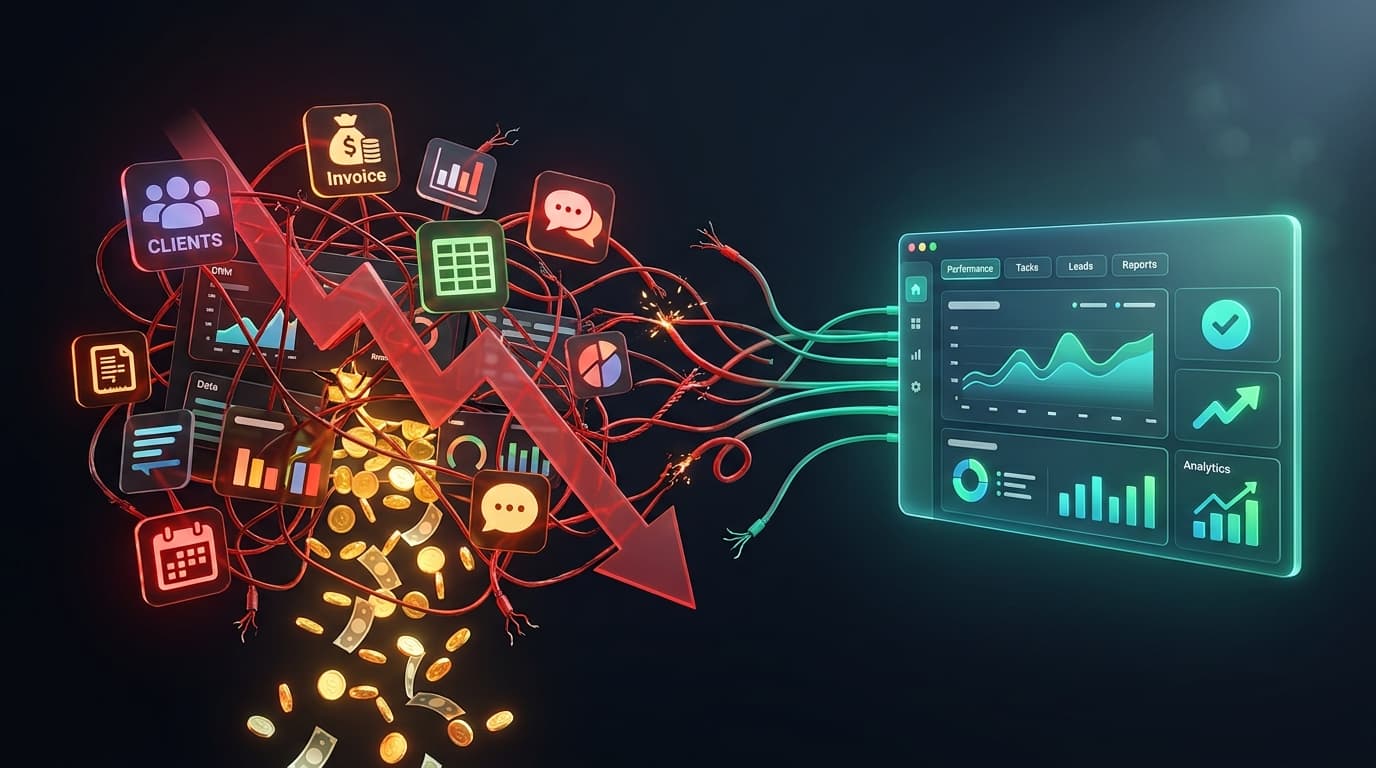
Disconnected business tools carry a cost far larger than their subscription fees: lost hours, duplicated work, decision-blind data silos and weaker security. Research shows staff toggle between apps around 1,200 times a day and spend roughly 60% of their time on "work about work" — the busywork that fragmented systems create instead of remove.
Most business owners can tell you exactly what their software costs. The debit orders are easy to add up: the CRM, the invoicing tool, the spreadsheet add-on, the email marketing platform, the chat app, the project tracker. What almost nobody has on a line item is the real cost — the tax you pay every single day because those tools don't talk to each other.
That tax is invisible, which is exactly why it's dangerous. It hides inside "that's just how long things take," inside re-typed data and Friday-afternoon reconciliations, inside the report that's always a week out of date. This article puts a number on it, shows what it looks like in a South African business, and lays out three clear ways to stop the leak.
What are disconnected business tools?
Disconnected business tools are the separate apps a company uses to run different parts of its operation — sales, finance, marketing, support, delivery — that hold their data in isolation and don't share it automatically. Each one does its job well enough on its own. The problem is the space between them, where information has to be copied, exported, re-keyed or chased by hand.
Almost no one chooses this on purpose. It accumulates. You start with an invoicing tool. A year later you add a CRM because sales is growing. Then a marketing platform, a support inbox, a shared spreadsheet that quietly becomes mission-critical. Each decision was sensible in the moment. Stacked together, they become a stack that nobody designed.
South African SMEs land here faster than most. Tight budgets favour cheap point solutions over one integrated system, urgent problems get solved with whatever tool is quickest to sign up for, and few small teams have in-house technical people to think about how it all fits together. The result, as local commentators have noted, is a patchwork of tools — each with its own login, its own security standard and its own island of data.
The hidden cost isn't the subscription — it's everything around it
Here's the mental shift that saves businesses real money: the monthly fee is the visible cost, and it's usually the smallest one. The expensive part is the friction — every place a human has to bridge a gap the software should have bridged itself.
That friction is measurable, and the numbers are sobering:
| Hidden cost | What it looks like day to day | Why it compounds |
|---|---|---|
| The toggling tax | Staff jumping between CRM, inbox, spreadsheet and accounting app to finish one task | ~1,200 app switches per person per day; roughly 4 hours a week lost just reorienting |
| Duplicated & manual re-entry | The same customer typed into three systems; numbers copied by hand into a report | Errors multiply and 44% of workers can't tell if work is being duplicated |
| Data silos / decision blindness | No single view of sales, cash and delivery at the same moment | Leaders decide on stale, partial numbers |
| Security & POPIA exposure | Personal data scattered across many tools and logins | A bigger attack surface and a harder compliance story |
| Toxic subscription spend | Overlapping tools and unused seats nobody cancels | Industry estimates put roughly a third of software spend as wasted |
None of these show up on an invoice. All of them show up in your margin.
How much time do disconnected tools actually waste?
More than almost anyone guesses. In a widely cited Harvard Business Review study that tracked teams across large enterprises, employees toggled between applications around 1,200 times a day. Those switches added up to just under four hours a week — about 9% of working time — spent simply reorienting after each jump. The researchers gave it a name that has stuck: the toggle tax.
Zoom out and it gets worse. Asana's Anatomy of Work research found the average knowledge worker spends roughly 60% of their time on "work about work" — searching for information, switching tools, chasing status updates and copying things between systems — rather than the skilled work they were actually hired to do.
Picture it as a relay race where every runner drops the baton at the handover and has to sprint back to pick it up. The team is working flat out. It's just not moving forward. For a South African business already contending with load-shedding and high data costs eating into the working day, hours lost to app-hopping are hours you genuinely cannot spare.
What are data silos — and why are they so expensive?
A data silo is information trapped inside one tool where the rest of the business can't reach it. Your sales numbers live in the CRM. Your cash position lives in the accounting app. Your delivery status lives in a spreadsheet. Each is accurate. None of them combine on their own — so no one ever sees the whole picture at the moment a decision has to be made.
This is not a fringe problem. In MuleSoft's 2025 Connectivity Benchmark, the average organisation ran 897 applications and only 29% of them were connected to one another. Ninety percent of organisations said data silos were actively creating business obstacles. Even at SME scale, where teams run dozens rather than hundreds of tools, the same trap holds: the more apps you add, the less any single one can tell you.
The cost is decision blindness. You have ten dashboards and no cockpit. You approve a big spend without seeing that three invoices are overdue. You push a marketing campaign at a product line that's quietly out of stock. A live executive dashboard that pulls every division into one view exists precisely to close this gap — to turn ten scattered dials into a single instrument panel a leader can actually fly by.
The re-entry tax: manual work and human error
When systems don't share data, people become the integration. A new customer gets typed into the CRM, then again into the accounting tool, then again into a delivery spreadsheet. Every keystroke is a chance for a typo, a mismatched reference number, a figure that no longer agrees between two systems.
Finance feels this most sharply. Reconciling a sales tool against an accounting package by hand is slow, and in South Africa it carries real stakes — VAT has to be right, and SARS-ready records have to reconcile. When tax-compliant invoicing and accounting sit inside the same system as your sales pipeline, a closed deal becomes an invoice becomes a reconciled payment without anyone re-typing a cent. The re-entry tax simply disappears.
See the leak in your own numbers. A short, no-obligation discovery call is enough to map where your tools hand off to humans — and what that handoff is costing you every month.
Do disconnected systems affect POPIA compliance and security?
Yes — and this is the cost most owners overlook until it's urgent. Every separate tool is another door into your business, another login to secure, another vendor holding your customers' personal information. Local research is blunt about the risk: digital fragmentation is a growing cybersecurity exposure for SMEs, and more than 70% of South African SMEs report having faced at least one attempted cyberattack.
POPIA sharpens the point. The Act expects you to know what personal information you hold, where it lives and to be able to act on it — securing it, and deleting it on request. That is difficult to promise when the same person's data is spread across six disconnected tools with no shared record of where it all sits. Consolidating onto fewer, connected systems shrinks your attack surface and makes compliance provable rather than hopeful. (For the practical detail, see our guide to POPIA compliance.)
How do you fix disconnected business tools?
You don't fix fragmentation by adding another app to manage the apps. You fix it by making your systems share one source of truth. There are three honest routes, and the right one depends on where you are today.
| Approach | Best for | The trade-off |
|---|---|---|
| Integrate the tools you already have | A stack that mostly works but doesn't talk | Integrations need ongoing upkeep, and gaps between tools remain |
| Adopt a business operating system | Teams tired of juggling eight logins and reconciling by hand | Some migration effort up front, one connected system afterwards |
| Build custom software | Workflows that off-the-shelf tools simply can't fit | A higher initial investment in exchange for an exact fit |
For most growing South African businesses, the shift that pays back fastest is moving to a single business operating system — one platform where sales, operations, marketing, finance and support share the same live data, so nothing has to be re-keyed and everyone sees the same truth. That's the "buy" path: fast to adopt, immediately connected.
When your operation has genuinely unique workflows — the kind of process that is your competitive edge — the "build" path fits better. Custom software, built to your exact process and integrated with what you already rely on, means the tool bends to your business instead of the other way around. Many businesses do both: a unified platform for the common functions, bespoke builds for the parts that make them special.
How to know it's time to consolidate
You don't need an audit to feel it. It's time to connect or replace your tools when the same information gets typed into more than one place, when your "current" numbers are always a few days old, when a straightforward report means exporting from three apps into a spreadsheet, when nobody can say with confidence where a customer's data lives, and when your team spends more of the day coordinating work than doing it. One of those is friction. Three or more is a hidden cost with your name on it.
The good news is that this is a solved problem. The tools to see your whole business on one screen, and to stop paying the toggle tax, already exist — and they're built for businesses your size.
Ready to find out what your disconnected stack is really costing you? Book a free, no-obligation discovery call with Syniq. We'll map your current tools, show you where the money and hours are leaking, and lay out the fastest path to a business that runs in sync.
Frequently asked questions
What are disconnected business tools? They're the separate apps a company uses for different functions — sales, finance, marketing, support — that keep their data in isolation and don't share it automatically. Each works on its own, but moving information between them relies on people copying, exporting or re-typing it by hand.
What is the hidden cost of disconnected business tools? It's everything around the subscription rather than the subscription itself: hours lost switching between apps, duplicated and re-typed data, human errors, decisions made on stale numbers, wasted spend on overlapping tools, and greater security and POPIA risk from data scattered across many systems.
How much time do employees lose switching between apps? A Harvard Business Review study found workers toggle between applications around 1,200 times a day, losing just under four hours a week — about 9% of their time — simply reorienting. Asana's research adds that roughly 60% of a typical worker's day goes to "work about work" rather than skilled work.
What are data silos and why do they cost money? A data silo is information trapped inside one tool where the rest of the business can't reach it. They cost money through decision blindness — leaders act on partial, out-of-date numbers — and through duplicated effort. MuleSoft's 2025 benchmark found the average organisation connects only 29% of its applications.
Do disconnected systems affect POPIA compliance? Yes. POPIA expects you to know what personal information you hold, where it lives and to secure or delete it on request. That's hard to guarantee when the same data sits across several disconnected tools. More logins and vendors also widen your attack surface, and over 70% of South African SMEs report at least one attempted cyberattack.
How do you connect or replace disconnected business tools? Three routes: integrate the tools you have, adopt a single business operating system that unifies sales, finance, marketing and support on shared data, or build custom software for workflows off-the-shelf tools can't fit. For most growing SMEs, a unified platform delivers the fastest payback, with custom builds reserved for the processes that set the business apart.