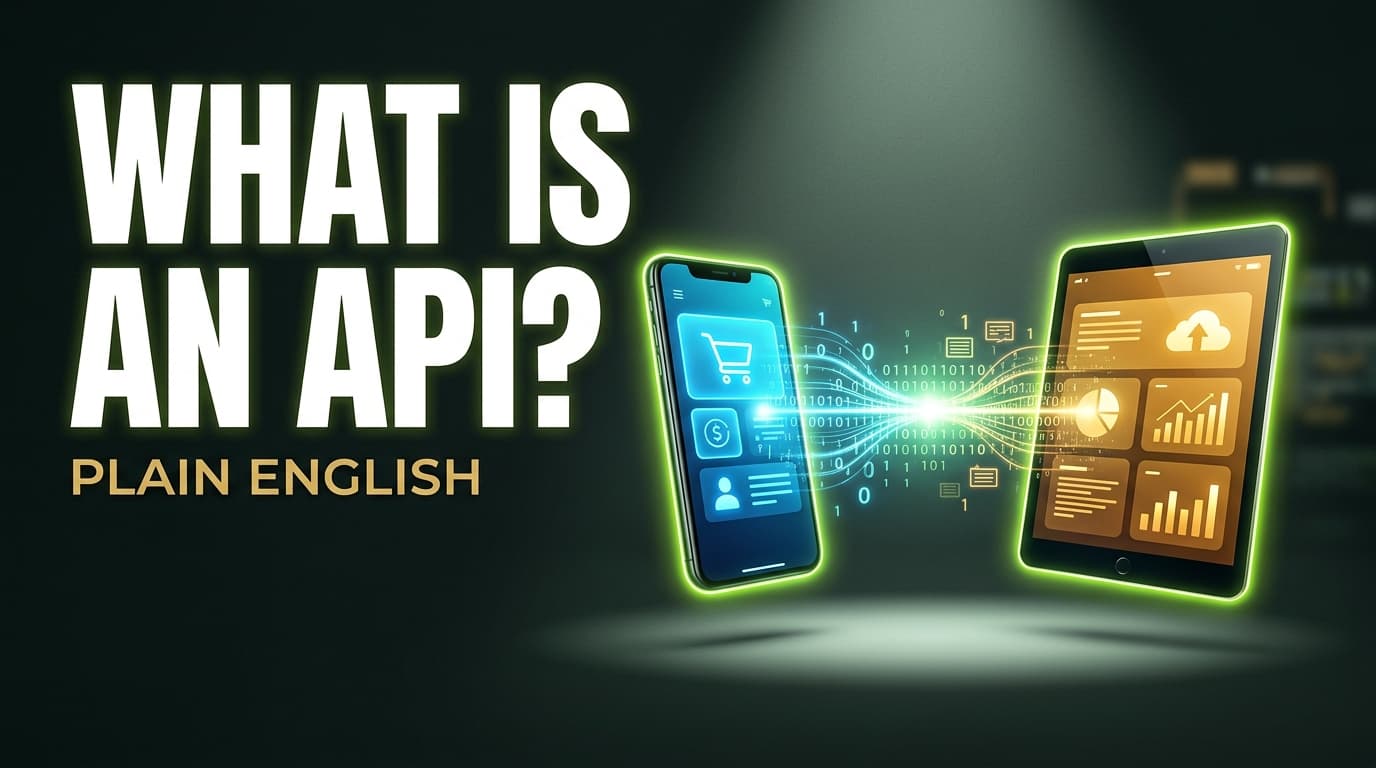
An API (Application Programming Interface) is a defined set of rules that lets two pieces of software talk to each other without a human in the middle. It is the difference between your invoicing system knowing a deal closed and someone retyping it. Business software without an API is a room with no doors — useful inside, isolated outside.
Most business owners meet the word "API" in a sales call, nod, and move on. That's a costly nod. Whether a system has a real API is one of the few technical questions that predicts, years ahead of time, how expensive your operations will be to run. This guide explains what an API actually is, why it matters commercially, and exactly what to ask a vendor before you sign.
What is an API in simple terms?
Think of a restaurant. You don't walk into the kitchen and cook. You read a menu, tell a waiter what you want, and food arrives. You never see the fridge, the chef, or the recipe.
An API is that waiter. Your accounting system doesn't get to rummage inside your CRM's database. Instead, the CRM publishes a menu — "you may ask me for a customer, create a deal, or update a contact" — and any other system can place an order against it. The rules are fixed, the requests are logged, and the kitchen stays private.
Three terms you'll hear alongside it:
- REST API — the most common style of API on the modern web. It works over the same protocol as your browser, using plain verbs:
GETto read something,POSTto create it,PUTto update,DELETEto remove. If a vendor says "we have a REST API," they mean a developer can connect to it using standard, well-understood tools. - Endpoint — a specific address on that API.
/customersreturns customers./invoices/1042returns one invoice. - API key / OAuth — how the system proves you're allowed to ask. A key is a long secret string. OAuth is a more careful handshake where you grant limited permission without ever sharing a password. SARS, for example, uses OAuth2 for approved eFiling integrations.
That's genuinely most of it. The concept is simple. The consequences are not.
Why does my business software need an API?
Because the alternative is people. Every system that cannot talk to its neighbours creates a human bridge — someone exporting a CSV, someone retyping an order number, someone checking on a Friday whether the two spreadsheets agree.
Here's what an API changes in practice:
A sale closes once. A deal marked Won in your CRM creates the invoice in your accounting module, triggers the onboarding task in operations, and adds the client to a welcome email sequence. Nobody re-enters anything. Nobody forgets.
Your numbers agree with each other. Disconnected tools drift. Revenue in the CRM says one thing, the accounting system another, and the board pack becomes an act of reconciliation rather than reporting. Shared data through an API means one version.
You keep your options. An API is also an exit. Software with a good API can hand your data to whatever comes next. Software without one holds your history hostage — and vendors know it.
You can automate the boring 80%. Payment gateways widely used in South Africa — PayFast, Yoco, Ozow, Netcash — all expose APIs precisely so a payment can update an invoice automatically. Accounting platforms like Sage and Xero have built SARS eFiling integrations on the same foundation. The plumbing exists. You only benefit if your systems can plug into it.
The commercial framing is blunt: an API converts recurring salary cost into a one-off build cost. A person doing two hours of copy-paste a day is a permanent line item. An integration is not.
Counting the manual handoffs in your business? Book a no-obligation discovery call and we'll map where your data is being retyped — and what it's costing you.
What is the difference between an API and a webhook?
This one comes up constantly, and the distinction is genuinely useful.
An API call is you asking. Your system reaches out: "Any new orders?" If you want to stay current, you have to keep asking — every minute, every hour. That's called polling, and it's wasteful.
A webhook is being told. You register a URL with the other system once, and it notifies you the instant something happens: "Order 4471 was just paid." Webhooks are sometimes called reverse APIs for exactly this reason.
| API (request) | Webhook (event) | |
|---|---|---|
| Who starts it | Your system | Their system |
| Timing | Whenever you ask | The moment it happens |
| Best for | Fetching data on demand, bulk lookups, searches | Payments, status changes, real-time alerts |
| Cost of staying current | High — constant polling | Low — one notification per event |
| Typical use | "Show me this customer's invoices" | "This invoice was just paid" |
Good software offers both. When you evaluate a vendor, ask which events they emit as webhooks — a short or vague list tells you how seriously they take integration.
How do I know if a vendor really has an API?
"We have an API" is a phrase, not a feature. Six questions separate the real thing from a marketing claim:
- Where is the public documentation? A real API has a URL you can read right now, without a sales call, with example requests and responses. No public docs is the single strongest warning sign.
- Is it included, or an upsell? Some vendors gate API access behind an enterprise tier. Ask for the price in writing before you commit.
- What are the rate limits? How many requests per minute? If the limit is low, high-volume syncing will break in month three, not on day one.
- Which webhooks do you emit? Ask for the event list.
- Can it write, or only read? A read-only API lets you report on your data. A read-write API lets you automate your business. These are very different products.
- What is your deprecation policy? How much notice do you get when they change something that breaks your integration? Mature vendors version their APIs (
/v1/,/v2/) and give months of warning.
If a vendor cannot answer these crisply, assume the integration work will land on you, and price the relationship accordingly.
Is it safe to connect systems by API under POPIA?
Connecting systems is not inherently a POPIA risk. Connecting them carelessly is.
Under the Protection of Personal Information Act, you remain the responsible party for personal information even when it flows through third-party software. So the standards you apply internally must follow the data outward. In practice:
- Send only what's needed. If a marketing tool needs an email address, don't hand it ID numbers. Minimisation is a POPIA principle, and APIs make it easy to honour — you control which fields cross.
- Secure the credentials. API keys are passwords. They belong in a secrets manager, never in a spreadsheet, a WhatsApp message, or committed source code.
- Encrypt in transit. Every request should be HTTPS. There is no acceptable exception.
- Know where the data lands. Cross-border transfers have specific requirements under section 72. Ask vendors where their servers are.
- Log everything. A proper integration leaves an audit trail. If you can't show who accessed what and when, you can't demonstrate compliance.
We go deeper on this in our practical POPIA guide for business software. The short version: an API integration built with intent is usually safer than the manual alternative, because a spreadsheet emailed between departments has no access control, no logging, and no expiry.
How much does an API integration cost in South Africa?
It depends almost entirely on what's on the other end. The pattern is consistent enough to plan around:
| Integration type | What's involved | Indicative range (ZAR) | Typical timeline |
|---|---|---|---|
| Off-the-shelf connector | Both systems already support each other; configuration only | R0 – R15,000 | Days |
| Standard two-system sync | Well-documented modern APIs on both sides, moderate field mapping | R25,000 – R75,000 | 2–4 weeks |
| Multi-system or custom logic | Three or more systems, business rules, data transformation | R80,000 – R250,000 | 4–10 weeks |
| Legacy or undocumented system | Old software, no public API, may need a database or file-based bridge | R150,000+ | 8 weeks+ |
Two costs people miss. First, maintenance — APIs change, and a connection nobody owns will eventually break silently. Budget for monitoring. Second, data cleanup — most integration projects surface the fact that the same client exists three times with different spellings. That work is real, and it's usually worth doing regardless.
These are indicative ranges for scoping conversations, not quotes. Scope, data quality, and the state of the systems on either end move the number substantially — book a scoping call for a fixed quote against your actual stack.
The alternative: fewer systems to integrate
There's a strategy people overlook while pricing connectors. Every integration you build is a connection you must maintain. Ten tools connected pairwise is a lot of plumbing.
Sometimes the better answer is consolidation. If your CRM, invoicing, operations, and support already share one database, there is nothing to integrate — the data is simply there. That's the premise behind Syniq Business OS: sales and tax-compliant accounting working off the same records, with APIs reserved for the outside world — your bank, your payment gateway, SARS — rather than for holding your own business together.
And where your workflow is genuinely unique, custom software built with an API-first design means the system you build today can talk to whatever you buy in three years. Doors, not walls.
Frequently asked questions
What is an API in simple terms? An API is a set of rules that lets two software systems exchange data or trigger actions without a person copying information between them. Like a restaurant menu and waiter, it defines exactly what you can ask for and keeps the kitchen private.
What does REST API mean? REST is the most common style of API on the modern web. It uses standard web requests — GET to read, POST to create, PUT to update, DELETE to remove — which makes it straightforward for developers to work with using well-understood tools.
What is the difference between an API and a webhook? An API call is your system asking for information. A webhook is the other system telling you the moment something happens. APIs are best for fetching data on demand; webhooks are best for real-time events like a payment clearing.
Do small businesses in South Africa really need APIs? If you use more than two business systems, yes. Every disconnected system creates manual data entry, and that cost recurs monthly forever. An integration is a one-off cost that removes it.
Are API integrations POPIA compliant? They can be, and often are safer than manual alternatives. Send only the fields required, secure API keys like passwords, use HTTPS everywhere, confirm where vendor servers are located, and keep an audit log of access.
How much does an API integration cost in South Africa? A standard two-system sync between well-documented modern platforms typically falls between R25,000 and R75,000. Multi-system or legacy integrations run higher. Book a scoping call for a fixed quote against your specific systems.
The bottom line
Every manual handoff in your business is a small, permanent tax on your team's time. Most of them can be removed — sometimes with an integration, sometimes by consolidating onto one platform.
Book a no-obligation discovery call and we'll show you which is which. Cape Town team, weekly demos, no offshore handoffs.
Syniq (Pty) Ltd is a Cape Town software company. We build custom software, web and mobile applications, and Business OS — an all-in-one operations platform for growing South African businesses.