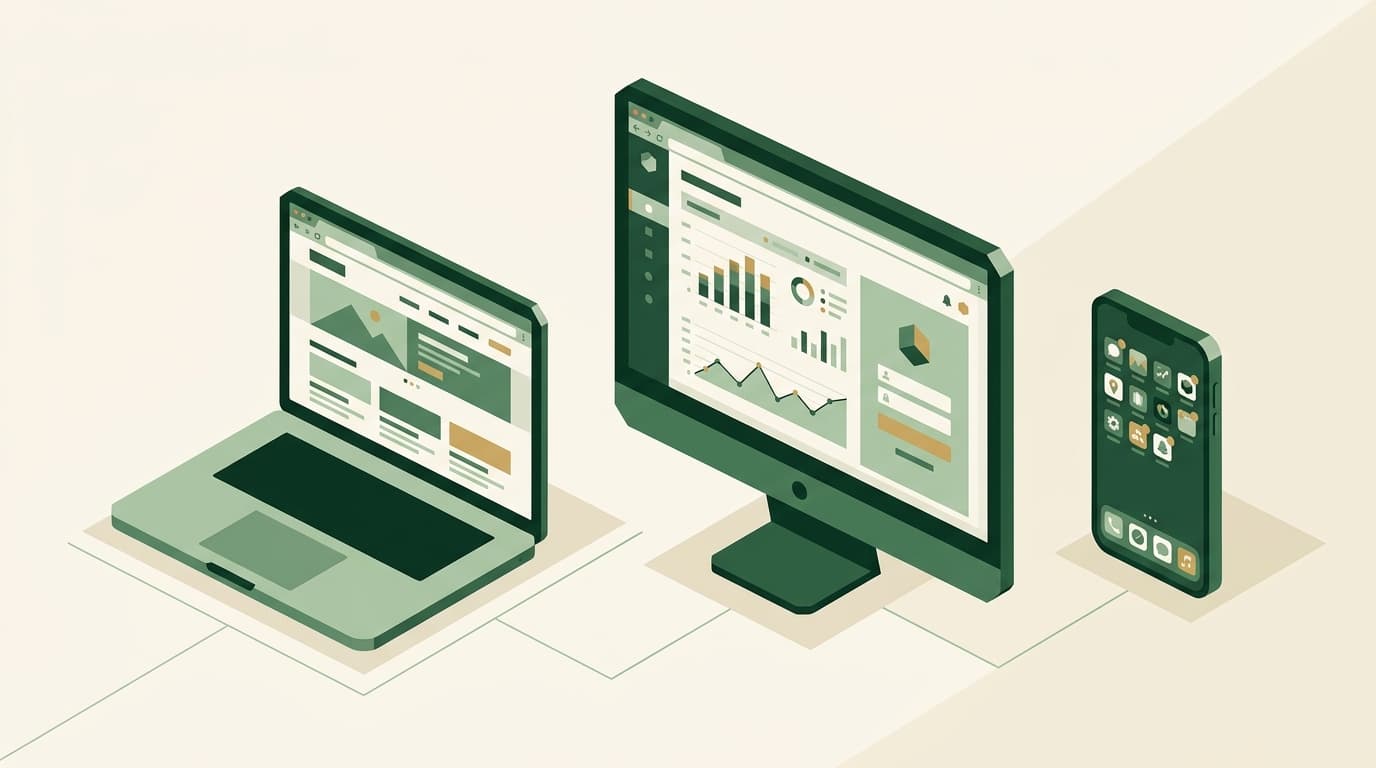
A website is mainly read — a set of pages you visit in a browser to find information. A web app is used — interactive software you log into and complete tasks in, still inside a browser. A mobile app is installed from an app store, built for phones, and can tap device features like the camera, GPS and push notifications. The three overlap, which is exactly why so many business owners pay for the wrong one.
If you have been quoted wildly different prices for "an app," this is usually why. The word covers three different things, with three different price tags and three different jobs. Below is a plain-English guide to telling them apart — and a simple way to decide which one your business actually needs.
Web app vs website vs mobile app: the short version
Think of it like a building. A website is the shop window — it shows passers-by who you are and what you offer. A web app is the workshop behind the glass — where people log in and get real work done. A mobile app is a toolbox someone carries in their pocket — always with them, built for the device in their hand.
Here is the same idea as a quick comparison.
| Aspect | Website | Web app | Mobile app |
|---|---|---|---|
| Primary job | Inform and publish | Get work done | Engage on the go |
| Where it runs | Any browser | Any browser | Installed on phone or tablet |
| Install needed | No | No | Yes — App Store / Play Store |
| Works offline | Rarely | Sometimes (with a PWA) | Often |
| Device features (camera, GPS, push) | Limited | Limited to moderate | Full |
| Updates reach users | Instantly | Instantly | When users update the app |
| Typical effort and cost | Lowest | Medium | Highest |
The lines blur in practice — a modern website can hold app-like features, and a web app can be made to feel like a native app. But the table above is the mental model to start from.
What is a website?
A website is a collection of pages people visit in a browser using your domain name. Its core job is to publish information: who you are, what you sell, where to find you, and why someone should trust you. Most of the traffic flows one way — from you to the visitor.
That doesn't mean websites are simple or low-value. A sharp, fast, well-structured website is often the single highest-return asset a South African business owns, because it works around the clock and is the first thing a prospect checks. Brochure sites, landing pages, blogs and most e-commerce storefronts live here.
You want a website when your priority is visibility, credibility and content — being found on Google and giving visitors a reason to get in touch. If that's the goal, start with professional web design and development rather than a heavier build you don't yet need. (For a full cost breakdown, see our guide on how much a website costs in South Africa.)
What is a web app, and how is it different from a website?
A web app is interactive software that runs in a browser. Instead of mostly reading, users do things: log in, capture data, run a search, generate an invoice, book a slot, track an order. The traffic flows both ways. Where a website hands you a brochure, a web app hands you a tool.
A few signals that you're looking at a web app rather than a website:
- It usually requires a login — accounts, roles and permissions.
- It stores and changes data based on what each user does.
- It replaces a manual process — a spreadsheet, a paper form, a WhatsApp thread.
You already use plenty of web apps: internet banking, your accounting dashboard, a CRM, a booking system. The huge advantage is reach without friction — anyone with a browser and a link can use it on a laptop or phone, and updates go live instantly for everyone with no download required.
Web apps come in two flavours. You can build a custom one tailored to exactly how your business runs — that's bespoke software development. Or you can buy a ready-made one and configure it, which is what platforms like Syniq Business OS are: an operations web app with CRM, invoicing, marketing and an executive dashboard already built, so you don't pay to rebuild the basics.
What is a mobile app?
A mobile app is software installed on a phone or tablet, downloaded from the Apple App Store or Google Play. Because it lives on the device, it can do things a browser struggles with: run offline, send push notifications, and use hardware like the camera, GPS, Bluetooth and fingerprint sensor as first-class features. Performance is typically faster and smoother because the app is built specifically for that platform.
That power comes at a price. A mobile app means app-store approval, support for both iOS and Android, and ongoing updates that users have to install. It's the heaviest of the three to build and maintain — so it should earn its place.
Reach for a mobile app when mobile use is central, not occasional: a delivery driver app that needs GPS and works in low-signal areas, a loyalty app sending push offers, or a field-service tool that captures photos on site. In a country where there were roughly 124 million mobile connections at the start of 2025 — more than two per three people — the case for mobile is strong, but only when the device features are part of the point.
What about a progressive web app (PWA)?
A progressive web app is the middle ground, and often the smartest first move. A PWA is a web app engineered to behave like an installed one: users can add it to their home screen, it can work offline, and it can send push notifications — all without an app-store download.
The economics are compelling. Because a PWA is one codebase that runs everywhere, it typically costs noticeably less than building separate native apps and reaches the market far faster. It also removes install friction: people can try it instantly from a link instead of committing to a download. For most business tools — customer portals, booking systems, e-commerce, internal dashboards — a PWA delivers the "app feel" your users want without the full cost and overhead of going native.
PWAs aren't right for everything. Games that need sustained high frame rates, heavy AR experiences, or apps leaning hard on specialised device hardware still benefit from native development. But for the everyday business app, a PWA is frequently the better value.
Not sure which of the three fits? That's exactly what a no-obligation discovery call is for. We'll map your goal to the lightest build that gets you there — and tell you honestly if you don't need the expensive option.
How much do they cost in South Africa?
Costs depend on complexity, integrations, design and platform, so treat the figures below as indicative ranges, not quotes. The only way to get an accurate number is to scope the project.
| Build | Indicative SA cost | What you get |
|---|---|---|
| Brochure website | From a few thousand rand to R60,000+ | Pages, content, contact forms, basic e-commerce |
| Custom web app / PWA | Scoped per project | Logins, dashboards, data, automation — one codebase across devices |
| Mobile app (MVP) | ~R80,000 – R250,000 | Login, profiles, push notifications, core flows |
| Complex mobile app | R1,000,000+ | Payments, real-time features, deep integrations |
Two cost levers are worth knowing. First, a PWA or web app usually costs meaningfully less than an equivalent pair of native apps, because you build and maintain one thing instead of three (web, iOS, Android). Second, choosing a cross-platform approach for native builds — frameworks like React Native — lets one team ship to both iOS and Android, which keeps the budget down versus writing each from scratch.
For platform pricing on the ready-made route, see Business OS pricing. For a bespoke build, the figure is whatever the scope demands — book a scoping call for a fixed quote.
Which one does your business actually need?
Skip the jargon and answer three questions:
- Is the goal mainly to be found and to inform? Build a website.
- Do users need to log in and complete tasks? Build a web app — custom if your workflow is unique, or buy a ready-made platform like Business OS if it isn't.
- Is mobile use, offline access or device hardware central to the experience? Build a mobile app (and consider a PWA first to prove demand at lower cost).
Most South African businesses are best served by starting light — a strong website or web app that validates real demand — and adding a native mobile app once usage and budget justify the step. The expensive mistake is building a mobile app first for a problem a web app would have solved for a fraction of the cost.
The right answer is the lightest build that achieves your outcome. That's the call we help founders make every week — no offshore handoffs, weekly demos, and POPIA-grade security built in from day one.
Frequently asked questions
Is a web app the same as a website? No. A website mainly delivers information to read, while a web app is interactive software you log into to complete tasks. Both open in a browser, which is why the two are so often confused — but their jobs and price tags are very different.
Do I need a mobile app, or is a web app enough? If your users mostly work at a desk or only need occasional access, a responsive web app or PWA usually does the job for less. Choose a native mobile app when offline use, push notifications, or device hardware like the camera and GPS are core to the experience.
What is a progressive web app (PWA)? A PWA is a web app that behaves like an installed app: users can add it to their home screen, it can work offline, and it can send push notifications — without downloading anything from an app store. It's often the best-value way to get an "app feel."
How much does a mobile app cost in South Africa? Indicative ranges start around R80,000 to R250,000 for an MVP and can exceed R1,000,000 for complex apps with payments and integrations. The exact figure depends on scope, so book a scoping call for a fixed quote.
Can one project cover both web and mobile? Yes. A PWA, or a cross-platform build using a framework like React Native, lets you reach web, iOS and Android from a largely shared codebase — lowering cost versus building each platform separately.
Which should I build first? Most businesses start with a website or web app to validate demand affordably, then add a native mobile app once usage and budget justify it. Build the lightest option that achieves your goal first.
Build the right thing, once
Web app, website or mobile app — the difference comes down to what you need it to do. Get that wrong and you overpay for power you'll never use, or outgrow a build within months. Get it right and the technology quietly compounds in your favour.
If you'd rather not guess, that's what we're here for. Book a no-obligation discovery call and we'll help you choose the lightest, smartest build for your business — and either design and build it for you or get you running on Business OS, whichever serves you better.