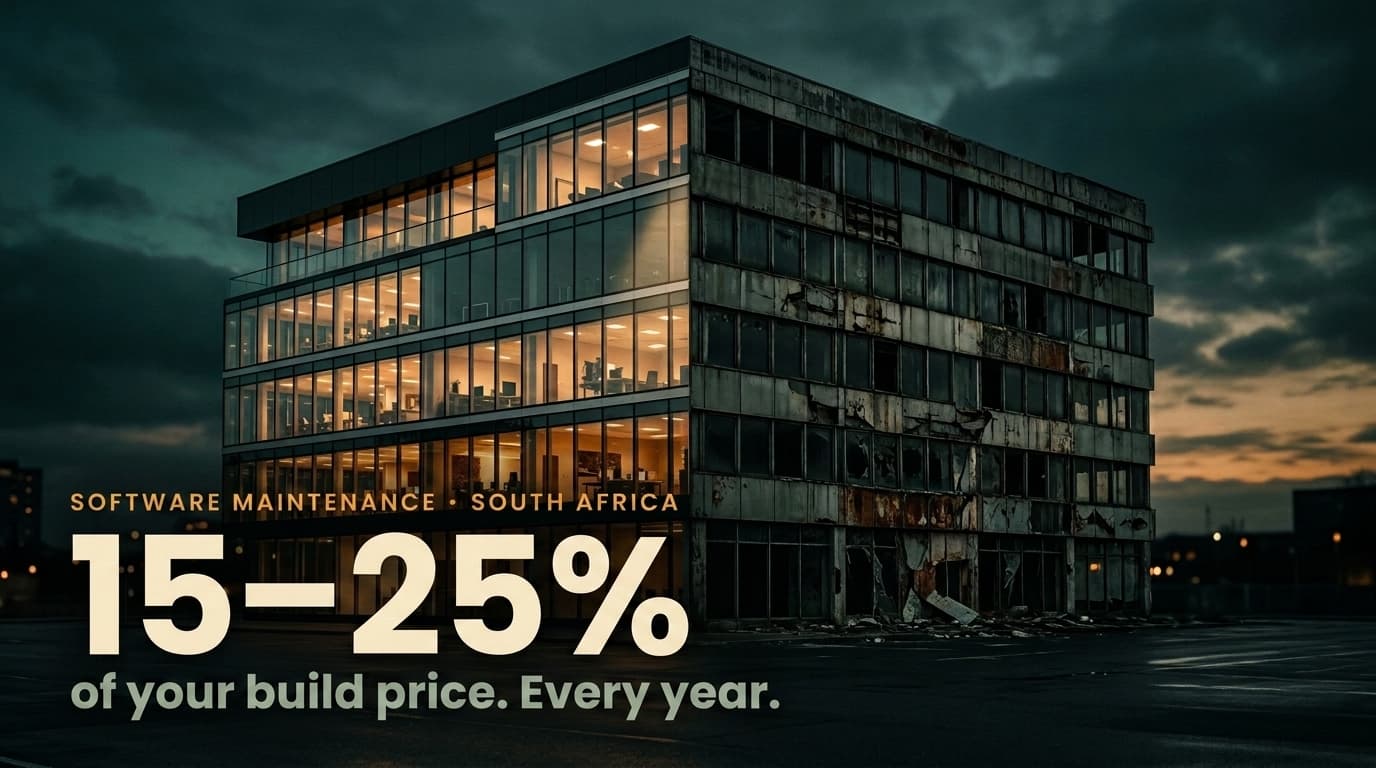
Budget 15–25% of your original build cost every year for software maintenance. On a R600,000 platform that's roughly R90,000 to R150,000 a year, or R7,500 to R12,500 a month. That covers bug fixes, security patching, dependency and platform upgrades, and small improvements. Hosting and infrastructure are billed separately.
Every founder who commissions custom software receives one number and remembers one number: the build price. It's the number on the quote, the number in the board pack, the number that gets approved.
It is not the number that matters most.
Software is not a building that goes up once and then stands. It sits inside an ecosystem that keeps moving underneath it — browsers update, operating systems ship new versions, app stores change their rules, libraries reach end-of-life, and attackers find new doors. Maintenance is what keeps your software standing while the ground shifts. Skip it, and the asset you paid for quietly turns into a liability.
Here's what it costs, what it buys, and how to plan for it properly.
What does software maintenance actually cover?
Software maintenance is a defined engineering discipline, not a vague support arrangement. The international standard for it, ISO/IEC/IEEE 14764, splits maintenance work into four categories — a useful frame, because most business owners only budget for the first one.
| Type | What it means | Real-world example |
|---|---|---|
| Corrective | Fixing defects found after launch | An invoice total rounds incorrectly on multi-currency orders |
| Adaptive | Keeping the software usable as its environment changes | Upgrading to a new Android API level so the app stays on the Play Store |
| Perfective | Improving performance or maintainability | A report that took 40 seconds now loads in 3 |
| Preventive | Finding and correcting latent faults before they surface | Patching a vulnerable dependency before it's exploited |
Notice that only the first category is what most people picture when they hear "support". The other three are the ones that arrive on a schedule you don't control — and they are the reason maintenance is a standing cost rather than an occasional one.
How much does software maintenance cost per year?
The long-standing industry benchmark is 15% to 25% of the original development cost, per year. That range has held up across decades of research and project data, and it's the number reputable development partners plan around.
Applied to typical South African build sizes — the bands we set out in our guide to what custom software costs in South Africa — the arithmetic looks like this:
| If your build cost | Annual maintenance (15–25%) | Roughly per month |
|---|---|---|
| R250,000 | R37,500 – R62,500 | R3,100 – R5,200 |
| R500,000 | R75,000 – R125,000 | R6,250 – R10,400 |
| R1,000,000 | R150,000 – R250,000 | R12,500 – R20,800 |
| R2,500,000 | R375,000 – R625,000 | R31,250 – R52,000 |
These are indicative planning ranges, not quotes. The actual figure depends on your architecture, integration count, compliance load, and how much of the system is genuinely bespoke. Book a scoping call and we'll give you a fixed number for your specific system.
Two adjustments worth knowing:
- Consumer-facing mobile apps sit higher, commonly 20–30% annually. They answer to two app stores, two operating systems, and a device fleet you don't control. If you're weighing an app build, our mobile apps page sets out how that ongoing load is structured.
- Legacy systems carrying heavy technical debt run 30–40%. When a codebase is old and undocumented, every small change costs more to make safely. That premium is the interest payment on technical debt someone else took out.
Why do maintenance costs rise as software gets older?
Because the gap between your software and the world around it widens every year, and closing that gap gets progressively more expensive.
Two live examples from right now make the point concretely.
App stores enforce deadlines. Google Play operates a rolling annual target API requirement. From 31 August 2026, new Android apps and updates must target Android 16 (API level 36), and existing apps must target at least Android 15 (API 35) to remain discoverable. An app that misses this doesn't get a warning email and carry on — it stops being shown to new users on newer devices. Developers can apply for an extension to 1 November 2026, but the direction of travel is fixed: stand still and you fall off the shelf.
Your foundations expire on a published schedule. Node.js, which underpins a large share of modern web platforms, gives each LTS release 12 months of active support followed by 18 months of maintenance — about three years from first release to end-of-life. Node.js 20 reached end-of-life on 30 April 2026. Running past EOL means running without security patches. That's not a technical inconvenience; it's an unpatched perimeter.
Neither of these is a defect in your software. Both cost real engineering hours. Both arrive whether or not you budgeted for them.
What are the running costs I can't avoid?
Separate from engineering time, every live system carries infrastructure costs. These are usually modest, but they should sit in the budget explicitly rather than surprising you on a card statement.
| Line item | Typical scale | Notes |
|---|---|---|
| Application hosting | From ~$20 per seat/month (Vercel Pro) | Scales with traffic and data transfer |
| Database & auth | From ~$25/month (Supabase Pro) | Usage-based above included limits |
| Domain & SSL | R150 – R400/year | SSL is usually bundled with hosting |
| Email & transactional messaging | R200 – R2,000/month | Volume-dependent |
| Monitoring & error tracking | R0 – R1,500/month | Free tiers cover most SME workloads |
| Backups & disaster recovery | Often bundled | Verify retention period, not just existence |
For most SME platforms, infrastructure lands somewhere between R1,500 and R8,000 a month. It is rarely the expensive part. Engineering time is.
Not sure what your current system is really costing you? Book a no-obligation discovery call and we'll map your build, your running costs, and your risk exposure onto one page.
Is software maintenance legally required under POPIA?
Effectively, yes — if your software touches personal information, which almost all business software does.
Section 19 of POPIA requires responsible parties to secure the integrity and confidentiality of personal information through appropriate, reasonable technical and organisational measures. Critically, that duty is ongoing: you must identify foreseeable risks, establish safeguards, verify that those safeguards actually work, and update them as new risks emerge.
Running software on an end-of-life framework with known, unpatched vulnerabilities is difficult to defend as a "reasonable technical measure". Maintenance isn't just hygiene — it's the evidence trail that proves you took your obligations seriously. We set out our approach in more detail on our POPIA page.
Retainer, ad-hoc, or in-house: which model fits?
There are three sensible ways to fund maintenance, and the right one depends less on your budget than on how much downtime actually costs you.
| Model | What you pay | Best for | The catch |
|---|---|---|---|
| Monthly retainer | A fixed monthly fee for a defined block of hours plus an SLA | Systems the business runs on daily | You pay in quiet months too |
| Ad-hoc / time & materials | Only for work performed, at an hourly rate | Low-risk internal tools with tolerant users | No guaranteed response time; queue position is not yours to choose |
| In-house developer | A full salary plus overheads | Businesses with a genuine product roadmap | One person covering one stack, with leave, illness, and resignation risk |
The decisive question is simple: if this system went down at 09:00 on a Monday, what would that cost us by 17:00? If the answer is meaningful, you want a retainer with a response-time commitment, because ad-hoc support means joining a queue at exactly the moment you can least afford to.
Retainers also change the economics of the work itself. When the same team maintains the system continuously, preventive work happens quietly and cheaply. When support is ad-hoc, everything becomes corrective — and corrective work under pressure is the most expensive kind there is.
How do you keep maintenance costs down?
Most of the levers are pulled during the build, not after it.
- Insist on a documented, conventional stack. Exotic technology choices feel clever in month one and cost you for a decade. Our builds run on Next.js, TypeScript, Supabase, PostgreSQL, Python and React Native precisely because they're well-supported, widely known, and hire-able against.
- Get automated tests from day one. Tests are the difference between a two-hour dependency upgrade and a two-week regression hunt.
- Own your code and your infrastructure. If you can't access the repository, you can't get a second opinion or a second supplier.
- Upgrade little and often. Six small dependency upgrades across a year cost far less than one heroic migration after three years of neglect.
- Consolidate. Every additional integration is another moving part with its own upgrade cycle and its own way of breaking.
That last point is the one businesses most often underestimate. Maintenance cost scales with surface area — and a stack of eight disconnected tools has a great deal of surface area.
What if you'd rather not maintain software at all?
Then don't build it.
That's not a contradiction of everything above — it's the honest other half of the decision. Custom software earns its maintenance cost when it encodes something genuinely specific to your business: a workflow competitors don't have, a process that is your actual advantage. For everything else — CRM, quoting, invoicing, support tickets, marketing sequences, executive reporting — a platform you subscribe to means the maintenance, patching, and platform upgrades are somebody else's line item.
That's the trade Business OS exists to make. Sales, operations, marketing, tax-compliant finance, support, and an executive dashboard in one system, on a predictable monthly fee, with the upgrade treadmill handled. You can see the numbers on the pricing page, and we compare the two commercial models directly in monthly SaaS vs a custom build.
The strongest position, in our experience, is usually both: subscribe for the commodity, build custom for the differentiator, and maintain a much smaller custom surface as a result. The same logic applies to your public presence — a well-built website should cost very little to keep current.
Frequently asked questions
How much does software maintenance cost per year in South Africa? Plan for 15–25% of your original build cost annually. A R600,000 system typically costs R90,000–R150,000 a year to maintain. Consumer mobile apps run higher, at 20–30%, and legacy systems with significant technical debt can reach 30–40%.
What is included in a software maintenance agreement? A proper agreement covers bug fixes, security patching, dependency and platform upgrades, hosting and uptime monitoring, backups, and a defined response-time SLA. It typically excludes new features, which are quoted separately. Always confirm what "support hours" actually means in the contract.
Is software maintenance the same as hosting? No. Hosting is the infrastructure your software runs on — usually R1,500 to R8,000 a month for an SME platform. Maintenance is the engineering time spent keeping the software correct, secure, and compatible. Hosting without maintenance keeps your software online while it slowly stops working.
What happens if I skip software maintenance? Initially, nothing visible. Then dependencies reach end-of-life and stop receiving security patches, app stores restrict distribution, integrations break as third-party APIs change, and the eventual catch-up rebuild costs several times what steady maintenance would have. Under POPIA, unpatched known vulnerabilities also weaken your Section 19 position.
Should I hire a developer instead of paying a maintenance retainer? Only if you have a genuine ongoing product roadmap. One developer costs a full salary plus overheads, covers one skill set, and takes leave. A retainer gives you a team across multiple disciplines with continuity of coverage — usually at lower total cost until your development needs are close to full-time.
Can I reduce maintenance costs after launch? Yes. Consolidate tools to reduce integration surface area, keep dependencies current in small regular increments rather than large infrequent ones, maintain automated test coverage, and move commodity functions onto a subscription platform so you maintain only what genuinely differentiates you.
Budget for the decade, not the launch
The build price buys you a working system on day one. The maintenance budget is what keeps it working on day one thousand — and it's the difference between software that compounds in value and software that quietly becomes the thing everyone works around.
Whether you're planning a new build, inheriting a system from a previous supplier, or trying to work out what your current setup really costs, we'll give you a clear picture and a fixed number.
Book a no-obligation discovery call → — Cape Town team, weekly demos, no offshore handoffs.
Syniq (Pty) Ltd — Cape Town. Design · Build · Transform.