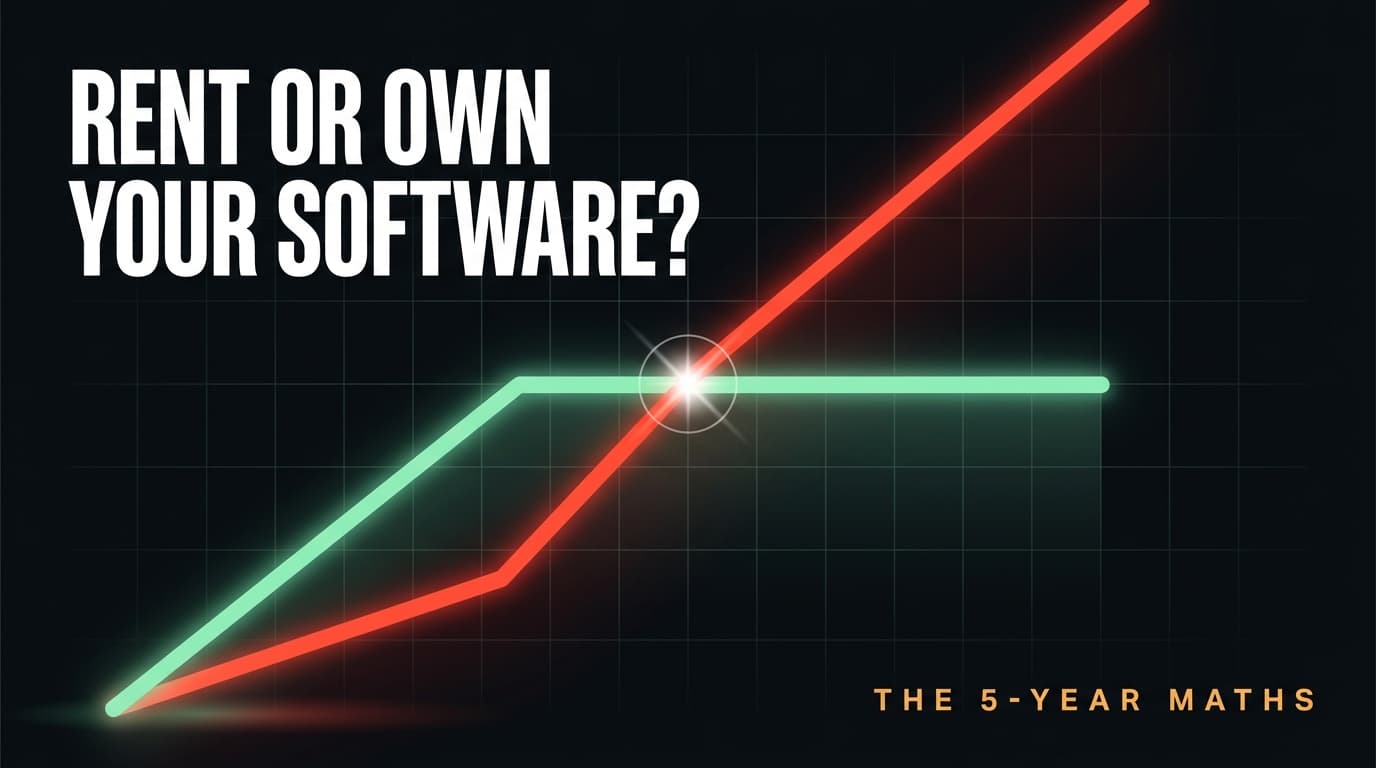
Monthly SaaS gets you running in days for a low upfront cost, but fees scale with headcount and rise most years. A once-off custom build costs more upfront — typically R300,000 upwards in South Africa — yet you own the asset, and for growing teams the total cost often breaks even within three to five years.
The decision feels like renting versus building a house — and just like property, the right answer depends on how long you plan to stay, how many people are moving in, and how unusual your floor plan is. This guide puts real numbers on both paths so you can run the maths for your own business, in rand, before you commit either way.
What's the real difference between paying monthly and paying once?
The difference is deeper than the payment schedule. It's a difference in what you're actually buying.
With monthly SaaS, you're buying access. The vendor owns the software, hosts it, secures it, and updates it. You pay per user (or per tier) for as long as you use it, and the moment you stop paying, the doors close. Your operating expense line carries the cost forever, but your capital stays free and your risk stays low.
With a once-off custom build, you're buying an asset. A development partner designs and builds software around your exact workflow, hands over the code, and the system belongs to your business. The upfront cost is significant, but there's no per-seat meter running — user number 5 and user number 50 cost the same to serve.
Here's how the two models compare at a glance:
| Factor | Monthly SaaS | Once-Off Custom Build |
|---|---|---|
| Upfront cost | Low (often R0 setup) | High (typically R300k+) |
| Ongoing cost | Per user, per month, forever | Maintenance (~15–25% of build cost/year) |
| Ownership | Vendor owns it — you licence access | You own the code and the data |
| Fit to your workflow | You adapt to the software | The software is shaped to you |
| Cost of adding users | Every seat adds cost | Effectively zero |
| Time to value | Days | Typically 3–9 months |
| Currency exposure (SA) | Often priced in USD — rand risk | Priced in rand |
| Price certainty | Vendor can raise prices annually | Costs are in your control |
Neither column is "the winner." The winner depends on your team size, growth rate, and how standard your processes are.
How much does each option actually cost in South Africa?
Monthly SaaS for business software typically runs from around R150 to R1,500+ per user per month depending on the category — a CRM seat, an accounting licence, a project management tool, a support desk. Most businesses run five to ten of these subscriptions side by side, so the meaningful number is your total monthly software spend across every tool, multiplied by every user.
Once-off custom builds in South Africa generally range from roughly R300,000 for a focused internal tool or MVP to R3 million+ for complex, integrated systems. The spread is wide because scope drives everything: a workflow app with three screens and one integration sits at the bottom of the range; a multi-division operations platform sits at the top.
Treat both sets of figures as indicative. Every project and every stack is different — book a no-obligation discovery call and we'll give you a fixed, scoped quote instead of a range.
When does a custom build break even against a subscription?
This is the question that settles most decisions, and it's pure arithmetic. Here's an illustrative example for a 40-person team paying an average of R500 per user per month across its core tools, with SaaS fees escalating 10% a year — in line with the 8–12% annual increases industry trackers like the Vertice SaaS Inflation Index have measured, roughly four times general inflation:
| Year | SaaS (cumulative) | Custom build (cumulative) |
|---|---|---|
| 1 | R240,000 | R600,000 (build) |
| 2 | R504,000 | R720,000 |
| 3 | R794,400 | R840,000 |
| 4 | R1,113,840 | R960,000 |
| 5 | R1,465,224 | R1,080,000 |
The custom column assumes a R600,000 build plus 20% of the build cost per year in maintenance from year two — the industry rule of thumb is 15–25%. In this scenario the lines cross in year four, and by year five the custom build is roughly R385,000 ahead. Run it again with 15 users and SaaS stays cheaper for the full five years. That's the whole game: headcount and time horizon decide the winner, not ideology.
Three variables move the break-even point most:
Team size. More seats make SaaS more expensive and custom relatively cheaper. Around 20–50 users is where the maths usually starts favouring a build.
Price escalation. SaaS pricing has been rising well ahead of inflation, and many tools South African businesses rely on are priced in dollars — so a weaker rand raises your software bill without a single vendor email.
Fit. If off-the-shelf covers only 70% of your workflow, the remaining 30% gets paid for in workarounds, spreadsheets, and manual re-entry. That cost never shows up on an invoice, but it's real. Our build vs buy decision framework digs deeper into how to weigh it.
What are the hidden costs of monthly SaaS?
The advertised per-seat price is the start of the bill, not the end of it. Watch for:
Tier creep. The feature you need next — API access, better reporting, more automation — usually lives one tier up. Analyst studies consistently find the true cost of a SaaS platform lands at a multiple of its sticker price once implementation, integrations, and add-ons are counted.
Annual increases. Renewal letters arrive with single- to double-digit percentage increases attached, and switching costs make them hard to refuse.
Per-seat scaling. Hiring ten people means buying ten more seats across every tool they touch. Growth gets taxed.
Integration glue. Five tools that don't talk to each other need connectors, middleware, or a person copying data between tabs — each one a cost.
Exit friction. Your data lives in the vendor's structure. Leaving means migration projects, export limitations, and sometimes ransom-shaped "data export" fees.
What are the hidden costs of a once-off build?
Fairness cuts both ways — "once-off" doesn't mean "pay once and never again."
Maintenance is non-negotiable. Budget 15–25% of the build cost per year for security patches, dependency updates, hosting, and small improvements. Software that isn't maintained doesn't stand still; it decays.
Hosting and infrastructure. Cloud hosting for a typical business system is modest — often hundreds to a few thousand rand per month — but it's a line item you now own.
Feature evolution. When your business changes, your software should change with it. That's development time, which is either a retainer or a project.
Partner risk. A build is only as good as the team behind it. Insist on owning your code and repository from day one, weekly demos so you see progress rather than promises, and a local team you can actually sit in a room with. That's how we run every engagement at Syniq's custom software division — Cape Town team, no offshore handoffs, POPIA-grade security baked in.
Can you combine both? The hybrid path
The choice isn't binary, and pretending it is leads to bad decisions.
The pattern we see work best for growing South African businesses: run your commodity functions on subscription software — the processes where you're similar to every other business — and build custom only where your process is your edge.
This is exactly why Syniq operates both divisions. Business OS is our subscription path: Sales & CRM, operations, marketing automation, tax-compliant invoicing, support, and an executive dashboard in one platform, priced transparently per month — one subscription replacing five or six separate tools, which resets the SaaS maths considerably. And when a client's workflow outgrows any off-the-shelf shape, our custom team builds the piece that fits — often integrated straight into their Business OS data.
Starting on subscription and graduating specific workflows to custom later isn't a compromise. For most businesses under 20 people, it's the correct sequence: prove the process first, then pour the foundation.
How do you decide? A five-question checklist
Ask these in order:
- How many users will touch this system in three years? Under 15: subscription maths usually wins. Over 40: run the break-even table above with your own numbers.
- Is this process a differentiator or a commodity? Nobody wins deals because of their leave-request tool. If the process is how you beat competitors, owning it matters.
- What does off-the-shelf not do for you? List the workarounds you'd need. If the list is short, buy. If the list is your whole operation, build.
- What's your cash position? A build is capital expenditure. If deploying R500k now would strain the business, a subscription keeps you liquid — and that flexibility has value.
- How long is your horizon? A custom build is a three-to-five-year investment minimum. If your model might pivot next year, don't pour concrete yet.
If you can answer those five questions, you already know your direction. If you're stuck between them, that's precisely what a scoping conversation is for — book a discovery call and we'll run the numbers with you, whichever path they point to.
Frequently asked questions
Is custom software cheaper than SaaS in the long run? Often, but not always. For teams of roughly 20–50+ users with a stable core process, a custom build typically breaks even against escalating subscription fees within three to five years. For small teams on standard workflows, SaaS usually stays cheaper.
How much does a once-off custom build cost in South Africa? Indicatively, from around R300,000 for a focused internal tool or MVP to R3 million+ for complex integrated systems. Scope drives the number — a scoped discovery call gets you a fixed quote rather than a range.
Why do SaaS prices keep going up? Industry trackers have measured average annual SaaS price increases of 8–12% — several times general inflation — driven by tier restructuring, add-on bundling, and vendors' own rising costs. Dollar-priced tools add rand exchange-rate exposure on top for South African businesses.
What ongoing costs does a once-off build have? Budget 15–25% of the initial build cost per year for maintenance, security updates, and hosting. A R600,000 build should carry roughly R90,000–R150,000 a year to stay secure and current.
Can I start on SaaS and move to custom software later? Yes — and for most growing businesses it's the smart sequence. Prove and stabilise your process on subscription software, then build custom for the workflows that outgrow it. Insist on tools that let you export your data cleanly so the migration path stays open.
Does Syniq offer both options? Yes. Business OS is our all-in-one subscription platform for sales, operations, finance, and support. Our custom software division designs and builds once-off systems you own outright. Many clients run both, integrated.
Stuck between a subscription and a build? Talk to Syniq — we run both models, so you'll get the numbers for your business rather than a pitch for whichever one we happen to sell.