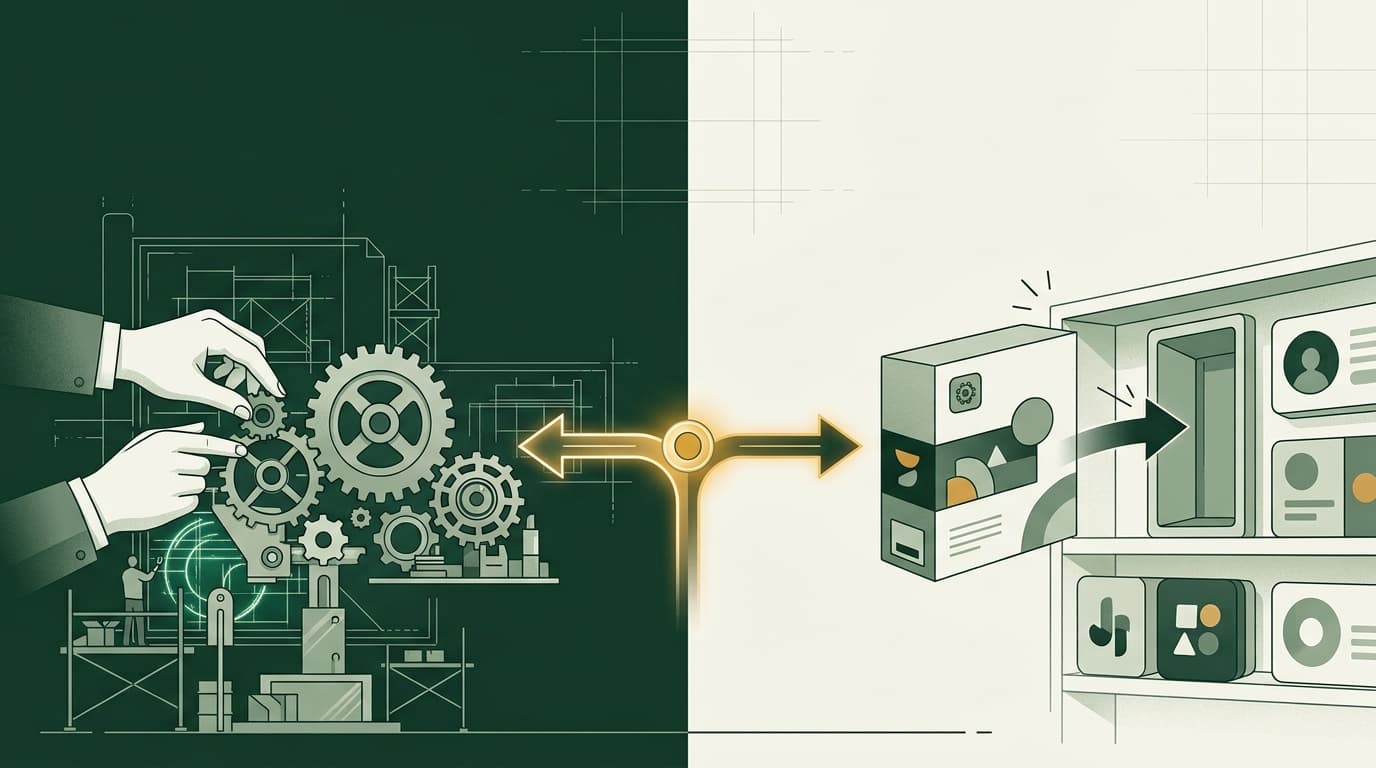
Buy off-the-shelf software when a function is a commodity your competitors run the same way. Build custom software when the workflow is a genuine differentiator, when off-the-shelf tools fit poorly, or when data control is non-negotiable. The sharpest test is not the sticker price — it is total cost of ownership over five years, weighed against speed, fit and risk.
Every growing company hits this fork. A spreadsheet stops coping, a process gets too specific for a template, or a subscription bill starts climbing faster than headcount. Someone asks the obvious question: do we buy a tool for this, or build our own? It sounds like a budget decision. It is really a strategy decision — and getting it wrong is expensive in either direction. Buy the wrong thing and you bend your business around someone else's software. Build the wrong thing and you sink months into a system that a R2,000-a-month subscription could have handled.
This guide gives you a framework to decide with confidence, localised for South African businesses.
What does "build vs buy" software actually mean?
"Buy" means licensing ready-made software — a SaaS subscription, an off-the-shelf platform, a packaged product. You rent capability that already exists. "Build" means commissioning custom software designed around your specific processes, whether that is an internal tool, a customer-facing web app, or a bespoke operations platform.
The instinct is to frame this as cheap-and-fast versus expensive-and-slow. That framing is wrong. Buying is faster to switch on, but you pay forever and you inherit every limitation of the product. Building costs more upfront, but the result is an asset you own outright and shape to fit. The right choice depends entirely on what the software is for.
When should you buy off-the-shelf software?
Buy when the job is a commodity — something thousands of other businesses do in more or less the same way, where being different buys you nothing. Accounting, payroll, email, file storage, standard CRM, calendar scheduling: these are solved problems. Reinventing them is a waste of good engineering time.
Buy when an off-the-shelf product already covers 80% or more of what you need, when you need it live now rather than next quarter, and when your team lacks the appetite to maintain software long-term. A good platform gives you battle-tested features, security patches and support without you lifting a finger.
The catch with buying is fragmentation. Businesses rarely buy one tool — they buy a dozen, and the seams between them leak time. Independent research on software stacks found that "best-of-breed" collections of disconnected tools demand dramatically more integration work, training and maintenance than a single all-in-one platform, and fail to integrate cleanly far more often. That is exactly why Syniq built Business OS — one connected system for sales, operations, marketing, finance and support — so growing South African businesses can buy broad capability without buying chaos. If you are replacing a legacy accounting package, our Sage alternative comparison is a useful starting point.
When should you build custom software?
Build when the software is the advantage — when a workflow is core to how you win, when it is too unusual for any template to fit, or when you have simply outgrown what you can buy.
McKinsey's long-running guidance on this decision reduces to a single line worth memorising: buy for commodity, build for differentiation. The strategic move is to concentrate custom engineering on the small share of your operation — often just 10–20% — that genuinely sets you apart: a proprietary pricing engine, unusual logistics logic, a matching algorithm, a customer experience no competitor can copy. McKinsey research suggests firms that align their custom builds tightly to their core business see meaningfully higher margins and faster growth than peers who spread effort thinly. Build there, and buy everything else.
Three signals point firmly toward building:
- Fit. You are drowning in workarounds, spreadsheets and manual copy-paste because no product matches your process.
- Economics at scale. Per-seat subscription fees — frequently priced in US dollars, so your rand cost drifts with the exchange rate — start to punish you as you grow.
- Control. You need to own your data, your roadmap and your compliance posture. For POPIA-sensitive operations, owning the system end to end can be the deciding factor (see our practical POPIA guide).
What does it really cost? Total cost of ownership, not sticker price
The most common mistake in this decision is comparing a subscription's monthly price to a custom build's project quote. That compares a rope to a knot. The honest comparison is total cost of ownership (TCO) over three to five years — every rand a solution costs to run, not just to acquire.
Buying looks cheaper than it is. Independent analyses put the true five-year cost of SaaS at roughly three to five times the headline subscription, once you add implementation, integration, training and administration — with the subscription itself often only 25–40% of the real total. Hidden integration and training work alone can add 150–200% on top of a licence fee over time. For mid-market organisations, the point where a well-scoped build becomes cheaper than continuing to rent — the break-even — often arrives around the 33-month mark.
Building looks more expensive than it is, because the number is front-loaded and then largely stops. You pay to design and develop once; after that you pay only for hosting and maintenance, and you carry no per-seat tax as your team grows.
| Factor | Buy (off-the-shelf / SaaS) | Build (custom software) |
|---|---|---|
| Upfront cost | Low — subscription or licence | Higher — design, development, QA |
| Time to value | Days to weeks | Weeks to months |
| Fit to your workflow | Good for standard processes; compromises at the edges | Exact — built around how you actually work |
| Ongoing cost | Per-seat fees that grow with headcount (often USD-priced) | Hosting + maintenance; no per-seat tax |
| Differentiation | None — rivals can license the same tool | High — the software becomes an asset you own |
| Control & data | Vendor sets the terms and roadmap | You own the code, the data and the direction |
| Best when | The function is a commodity | The function is a differentiator |
How much does it cost to build custom software in South Africa?
Local salaries anchor the honest answer. In 2026, a mid-level South African developer costs on the order of R350,000–R490,000 a year, while senior engineers run from R600,000 to well over R1,000,000, with Cape Town and Gauteng typically 10–20% above the national median. A small in-house product squad — a couple of developers plus design, QA and product oversight — comfortably runs past R1.5 million a year fully loaded, before a single feature ships. That is the real cost of "building it ourselves" the hard way.
Working with a focused delivery partner changes the maths, because you pay for output rather than a standing payroll. At Syniq, custom builds typically start in the low hundreds of thousands of rand for a tightly scoped MVP and scale with complexity — but we never quote a number from thin air. Every engagement is priced with a fixed quote after a short scoping call, so you know the cost before you commit. Book a discovery call and we will size it honestly against buying.
What are the risks of building your own software?
Building is not free of danger, and pretending otherwise helps no one. The long-running Standish Group CHAOS studies are sobering: historically only about one in six software projects finished on time, on budget and on scope, and even with modern methods only around a third are counted as fully successful. The pattern underneath the numbers is the important part — small, tightly scoped projects succeed roughly nine times out of ten, while large "big bang" builds succeed less than one time in ten.
The lesson is not "never build." It is "never build big and blind." De-risk a build the same way you would de-risk any large commitment: start with a minimal, valuable slice; ship it; learn; expand. That is why Syniq works in short cycles with weekly demos and an in-house Cape Town team rather than offshore handoffs — so you see working software early and often, and course-correct before the budget is gone rather than after. A build should feel like watching a house go up brick by brick, not signing a cheque and hoping.
The build-vs-buy decision framework
Run any candidate decision through these six questions. The more answers that fall on one side, the clearer your path.
| Ask yourself | Lean BUY | Lean BUILD |
|---|---|---|
| Is this workflow a core differentiator? | No — everyone does it the same way | Yes — it is how we win |
| Does off-the-shelf fit 80%+ of our needs? | Yes | No — too many gaps and workarounds |
| How fast do we need it live? | Now / this quarter | We can invest for a bigger payoff |
| Are our processes unusual or complex? | No | Yes |
| Are data-control and POPIA demands strict? | Standard | Non-negotiable |
| What happens to cost as we scale? | Per-seat pricing stays acceptable | Per-seat pricing becomes punishing |
If most answers land in the BUY column, get a connected platform live quickly and spend your energy on customers, not code. If they land in BUILD, invest where you differentiate and protect the project with tight scope and short feedback loops.
Do you have to choose? The hybrid path
For most South African businesses, the smartest answer is not build or buy — it is both, in the right places. Buy the commodity backbone: run your sales, finance, operations and support on a single Business OS so nothing falls through the cracks between disconnected tools, and see the whole picture on one dashboard. Then build only the 10–20% that is truly yours — the workflow, product or customer experience no competitor can license.
This "composable" approach gives you speed where speed is all that matters and craftsmanship where craftsmanship wins deals. It is also how you keep total cost of ownership sane: you are not paying to build commodities, and you are not renting your competitive edge from a vendor who will happily sell the same thing to your rivals. Compare Business OS pricing against the cost of a build, and the split usually decides itself.
Not sure where the line sits for your business? That is exactly the conversation a scoping call is for. Talk to Syniq — no obligation, just a clear recommendation on what to buy, what to build, and what to leave alone.
Frequently asked questions
Is it cheaper to build or buy software? Over the first year, buying is almost always cheaper. Over three to five years it depends on total cost of ownership. SaaS often costs three to five times its headline subscription once implementation, integration and per-seat growth are counted, and mid-market break-even against a custom build frequently arrives around 33 months. Compare full TCO, not month-one price.
When should a small business build custom software? Build when the software is a genuine competitive advantage, when off-the-shelf tools force constant workarounds, when per-seat subscription costs punish your growth, or when you must own your data and compliance outright. If the function is a commodity everyone runs the same way, buy it instead.
What is total cost of ownership (TCO) in build vs buy? TCO is every rand a solution costs to run over its life, not just to acquire — subscriptions or development, plus implementation, integration, training, maintenance, hosting and admin. The subscription line is often only 25–40% of a SaaS tool's real cost. TCO is the only fair way to compare renting software to owning it.
How much does it cost to build custom software in South Africa? It depends on scope, but the anchors are local: a mid-level developer costs roughly R350,000–R490,000 a year and a small in-house squad runs past R1.5 million annually. With a delivery partner you pay for output instead, and a scoped MVP typically starts in the low hundreds of thousands. Syniq gives a fixed quote after a scoping call.
Can you build and buy at the same time? Yes — and for most businesses that is the best answer. Buy a connected platform for commodity functions like finance, sales and support, then build only the 10–20% of workflow that truly differentiates you. This composable approach keeps total cost of ownership low and your competitive edge in your own hands.
What are the biggest risks of building your own software? Cost and schedule overruns on oversized projects. Standish CHAOS data shows small, tightly scoped builds succeed around 90% of the time while large "big bang" builds succeed under 10%. Mitigate by starting with a minimal valuable version, shipping early, and working with a team that demos weekly so you can course-correct fast.