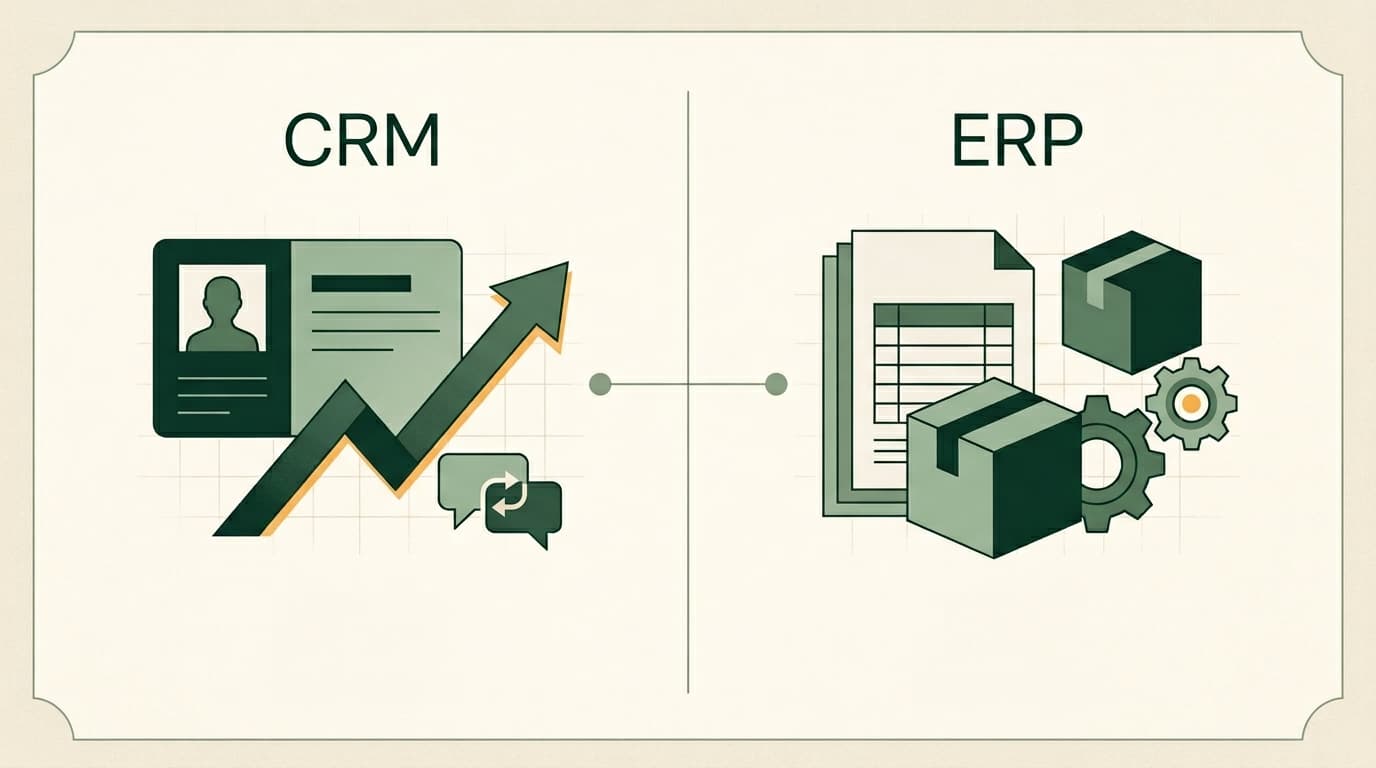
CRM (Customer Relationship Management) software runs your front office — sales, marketing and customer service — to win and keep customers. ERP (Enterprise Resource Planning) software runs your back office — finance, inventory, operations and HR — to control cost and keep work flowing. Most growing South African businesses eventually need both; increasingly, a single business operating system delivers them together.
If you've ever sat in a demo nodding along while two acronyms get used interchangeably, you're not alone. CRM and ERP solve different halves of the same problem: running a business well. One looks outward at the customer. The other looks inward at the operation. Get the distinction right and you buy the tool that actually moves your numbers. Get it wrong and you pay for software your team never adopts.
Here's the plain-English breakdown, with South African pricing and a decision framework you can use this week.
What is a CRM system?
A CRM is the system of record for everything that touches a customer. Think of it as the shared memory of your sales and service teams — every lead, conversation, quote, deal and support ticket in one place, so nobody has to ask "who last spoke to this client?"
A capable CRM typically handles:
- Lead and contact management — capturing enquiries and keeping a single, clean record per customer.
- Sales pipeline — moving deals through defined stages so you can forecast revenue, not guess at it.
- Marketing — email campaigns, segmentation and follow-up automation.
- Customer service — tracking support requests through to resolution.
The goal of a CRM is growth: more qualified leads, higher conversion, better retention. It's used mostly by the people who carry a number — sales, marketing and support. In Syniq's Business OS, the Sales & CRM module covers exactly this front-office territory, from first touch to closed deal.
What is an ERP system?
An ERP is the engine room. Where a CRM manages relationships, an ERP manages resources — money, stock, people and processes — and keeps every department working from the same set of accurate, real-time numbers.
A typical ERP brings together:
- Finance and accounting — invoicing, expenses, the general ledger and tax.
- Inventory and procurement — what you hold, what you owe, what you need to reorder.
- Operations — order fulfilment, project delivery and resource scheduling.
- HR and payroll — staff records and pay runs (in many suites).
The goal of an ERP is efficiency: lower cost, less duplication, and one source of truth instead of a dozen spreadsheets that disagree with each other. For South African businesses, the accounting layer matters most, because it has to be locally correct — VAT handling, SARS-compliant invoicing and clean records for your auditor. That's the job of Syniq's tax-compliant invoicing and accounting module.
CRM vs ERP: what's the key difference?
The simplest way to hold it in your head: a CRM helps you make money; an ERP helps you keep it. One grows the top line, the other protects the bottom line. Here's how they compare across the dimensions that matter.
| Dimension | CRM | ERP |
|---|---|---|
| Primary focus | Customer relationships (front office) | Business operations (back office) |
| Core users | Sales, marketing, support | Finance, operations, inventory, HR |
| Main goal | Grow revenue | Reduce cost, improve efficiency |
| Key modules | Leads, pipeline, contacts, campaigns, service tickets | Accounting, invoicing, inventory, procurement, payroll |
| Headline metric | Conversion and retention | Margin, cash flow, stock turn |
| Typical SA entry cost | ~R200–R900 per user/month | From ~R2,000/month; R50k–R250k/year |
| Time to value | Days to weeks | Weeks to months |
Notice the overlap in the middle. Both systems hold customer information. Both touch the order. The difference is what happens around it: a CRM is built to nurture the relationship that creates the order, while an ERP is built to fulfil, invoice and account for it. When they're disconnected, that order gets keyed in twice — once by sales, once by finance — which is exactly where errors and lost hours creep in.
Does your business need a CRM or an ERP?
Start with the bottleneck that's actually costing you, not the software category.
Lean towards a CRM first if your pain is on the revenue side: leads slipping through the cracks, no reliable sales forecast, follow-ups depending on one person's memory, or marketing you can't measure. If you're a sales-led agency or a growing services business, a CRM usually delivers a faster, more visible return.
Lean towards an ERP first if your pain is operational: stock you can't trust, invoicing that lags, finance reconciling across tools, or month-end that swallows a week. Businesses that move physical product, run complex projects, or operate across multiple sites tend to feel the ERP gap first.
For context, South Africa has roughly 2.69 million small, medium and micro enterprises, contributing an estimated 40% of GDP and the majority of private-sector employment. The overwhelming majority of them don't start with enterprise software at all — they start with spreadsheets and WhatsApp, then hit a ceiling. The question is rarely "CRM or ERP forever?" It's "which gap do I close first, and will today's choice still fit when I've doubled?"
That second half is where many owners get caught. They buy a standalone CRM, then a separate accounting package, then a project tool — and end up re-typing the same customer into three systems.
Weighing up your options? A 20-minute no-obligation discovery call will map your actual bottleneck to the right tool — no sales theatre, just a clear recommendation.
How much do CRM and ERP cost in South Africa?
Pricing is where the two categories separate most sharply. CRMs are priced per user per month and you can be live in days. ERPs carry heavier configuration, more users and often an implementation project, so the numbers — and the timelines — are larger.
The ranges below are indicative South African market figures to help you budget. Your real cost depends on users, modules and complexity, so treat any quote as a starting point.
| Software | Indicative SA pricing | Best suited to |
|---|---|---|
| Entry-level CRM | ~R220–R500 per user/month | Sales teams getting organised |
| Mid-market CRM | ~R500–R900+ per user/month | Larger sales + marketing teams |
| Cloud (SaaS) ERP | From ~R2,000/month | SMEs needing finance + operations |
| ERP licence (annual, all-in) | ~R50,000–R250,000/year | Established SMEs scaling up |
| ERP implementation (once-off) | ~R200,000–R5,000,000+ | Complex, multi-site operations |
| Connected business OS | Scoped to your needs | Teams wanting CRM + operations in one |
Two local cost notes worth flagging. First, many global CRM and ERP vendors bill in US dollars, so your monthly cost rides the rand exchange rate — a tool that's affordable in January can sting by June. Pricing in ZAR makes budgeting predictable. Second, the headline licence is rarely the full bill: implementation, data migration, integrations and training are real line items, especially for ERP. If you're comparing a long-established suite, it's worth reading our take on a modern alternative to Sage before you commit. You can also see Syniq's transparent Business OS pricing for a like-for-like reference point.
Do you actually have to choose? The case for one connected system
Here's the shift that changes the whole question. For most South African SMEs, the honest answer to "CRM or ERP?" is both — but not as two separate purchases.
When your CRM and your operations live in different tools, you create a seam. A deal closes in the CRM, but finance doesn't see it until someone re-enters it. Stock sells, but the salesperson quoting the next client doesn't know it's gone. Every seam is a place for data to drift, for hours to leak, and for two people to confidently quote different numbers in the same meeting.
A business operating system removes the seam by putting the front office and back office on one shared data layer. Syniq's Business OS is built exactly this way: Sales & CRM, Operations, Marketing, Finance and Support all feed a single executive dashboard — so the deal your salesperson closes is the same record finance invoices and the same number you see on your screen at month-end. One source of truth, "Manage · Automate · Scale," instead of a stack of tools that argue with each other.
There's a compliance dividend too. Under POPIA, any system holding customer names, numbers or emails must process that data lawfully — with proper consent, encryption and clear data handling — and non-compliance can carry fines of up to R10 million. Spreading customer data across several disconnected, offshore-hosted tools makes that genuinely hard to govern. Consolidating onto one platform with POPIA-grade data handling makes it far simpler to know where personal information lives and who can touch it.
Tired of tools that don't talk? Book a discovery call and we'll show you what your sales, operations and finance look like on a single connected platform.
What if off-the-shelf doesn't fit?
Sometimes the honest answer is that no boxed CRM or ERP matches how you actually work — you have a workflow that's a genuine competitive advantage, or an industry quirk that standard software fights against. That's the moment to consider building rather than buying.
This is the "build" path: custom software designed around your process instead of forcing your process around someone else's product. It's not the right call for everyone — off-the-shelf wins on speed and cost for standard needs — but where your operation is the differentiator, bespoke can pay for itself. (A future post will dig into the full build-vs-buy decision; for now, the short version is: buy for the common, build for the rare.)
The decision isn't really CRM vs ERP. It's this: close your most expensive gap first, and choose tools that will still fit when you're twice the size. For most growing South African businesses, that points towards one connected platform rather than a drawer full of disconnected logins.
Frequently asked questions
What is the difference between CRM and ERP?
A CRM manages your front office — customer relationships, sales, marketing and support — with the goal of growing revenue. An ERP manages your back office — finance, inventory, operations and HR — with the goal of running efficiently. CRM helps you make money; ERP helps you keep it.
Is an ERP the same as accounting software?
No. Accounting is one module inside an ERP. A full ERP also covers inventory, procurement, operations and often HR and payroll, all sharing one database. Standalone accounting software handles the books but doesn't connect the rest of your operation.
Should a small business start with a CRM or an ERP?
Start with whichever gap is costing you most. Sales-led and services businesses usually feel the CRM gap first; product- and operations-heavy businesses feel the ERP gap first. Better still, choose a connected platform so you don't have to bolt the two together later.
How much does a CRM cost in South Africa?
Most paid CRM plans for small teams run from about R220 to R900 per user per month, depending on features. Billing in rand rather than US dollars keeps your costs predictable against exchange-rate swings.
Can one system do both CRM and ERP?
Yes. Integrated platforms — often called a business operating system — combine CRM and operational/ERP-style modules on one shared data layer, so sales, finance and operations work from the same real-time information instead of separate tools.
Do CRM and ERP systems need to be POPIA compliant?
Yes. Any system storing customers' personal information must comply with POPIA's conditions for lawful processing, including consent, security and data-subject rights, with penalties of up to R10 million. Fewer, well-governed systems make compliance far easier than several disconnected ones.
Not sure whether you need a CRM, an ERP, or one platform that does both? Book a no-obligation discovery call and Syniq's Cape Town team will map your bottleneck to the right solution — clearly, with no jargon.