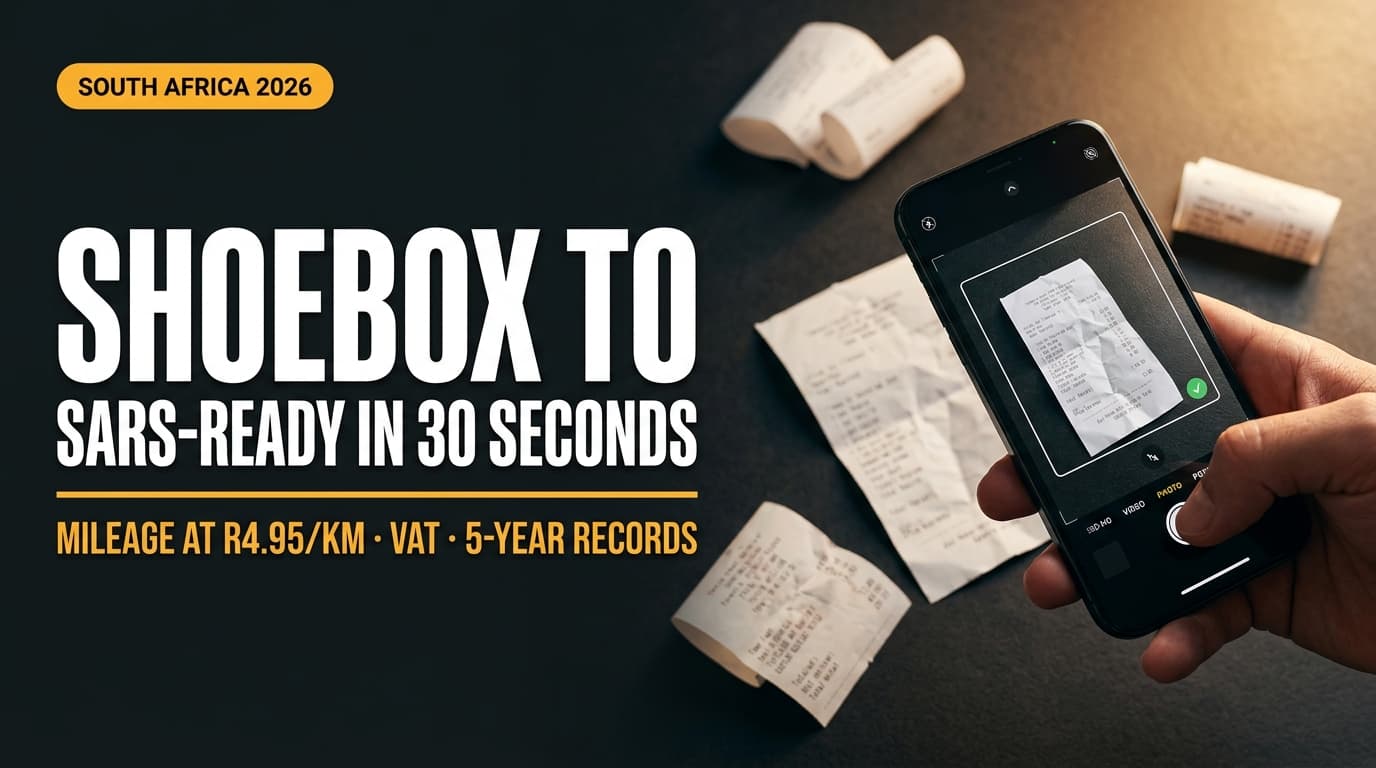
Expense management software captures staff spending at the moment it happens — a photographed slip, a logged trip, a card swipe — routes it to the right approver, and files it as a record your accountant and SARS can both work from. In South Africa it also has to respect the prescribed rate per kilometre, subsistence limits, VAT invoice rules and a five-year retention period.
Most businesses do not buy expense software because claims are slow. They buy it because month-end has become an archaeology exercise: three staff members chasing slips they photographed in a parking lot, a mileage claim nobody can reconcile to a logbook, and a bookkeeper deciding whether a R430 restaurant bill was a client lunch or a Tuesday.
This guide covers what the software does, the South African rules it has to satisfy, what it costs in rand, and how to choose between a standalone tool and the module already sitting inside your operations platform.
What is expense management software?
Expense management software is the system that handles money your business spends outside the invoice-and-purchase-order path — the fuel, the flights, the client coffees, the parking, the emergency courier. It replaces the claim form with a structured record and an approval trail.
A working system does six things:
- Capture. Staff photograph a slip on their phone and the system reads the date, supplier, total and VAT amount off it.
- Categorisation. Each expense is coded to a general ledger account, a cost centre, and where relevant a client or project.
- Mileage. Business trips are logged with start point, destination, reason and distance — the raw material of a SARS-acceptable logbook.
- Approval routing. Claims go to the right approver based on value, department or budget, with a record of who approved what and when.
- Policy enforcement. Claims that breach a limit or arrive without a valid tax invoice are flagged before they reach finance, not after.
- Reimbursement and posting. Approved claims flow into payroll or a payment run, and into the ledger, without re-keying.
The distinction that matters is between recording an expense and proving it. A spreadsheet records. Software that timestamps the capture, keeps the original image unaltered and locks the approval trail is what proves it three years later when someone asks.
What does a South African expense system have to get right?
Four local rules shape what a claim record must contain. Any tool you consider should handle all four without a workaround.
| What staff claim | The South African rule | What the system must capture |
|---|---|---|
| Business travel in an own vehicle | Reimbursement at or below the SARS prescribed rate is not taxed, provided the travel is for business and supported by a logbook | Date, start and end point, business reason, kilometres, rate applied |
| Meals and accommodation away overnight | SARS deems a daily amount spent, so an allowance up to that limit is exempt | Nights away, destination, whether meals were included in the allowance |
| Anything with VAT on it | Input VAT needs a valid tax invoice; full invoice above R5,000, abridged between R50 and R5,000 | Legible invoice image, supplier VAT number, VAT amount split out |
| Everything | Records must be kept for five years and remain complete, unaltered and retrievable | Original document image, immutable audit trail, export on demand |
The mileage rule most claims get wrong
For the 2027 year of assessment — 1 March 2026 to 28 February 2027 — the SARS prescribed rate is R4.95 per kilometre, up from R4.76. Reimburse a staff member at or below that rate for genuine business travel and the payment is not taxed in their hands. Pay above it and the excess is included in remuneration for PAYE.
On 1,200 business kilometres in a month, that is R5,940 reimbursed with no tax consequence — provided the logbook exists. The catch is in the wording: the reimbursement must be based on actual distance travelled, and this treatment is not available if the employee also receives a travel allowance or other reimbursement for the same vehicle, other than for parking and tolls.
This is precisely where spreadsheets fail. A monthly figure typed into a cell is not a logbook. A trip-by-trip record with dates, destinations and reasons is. Good software makes the second one the path of least resistance — which is the only way it actually gets done.
Subsistence: what SARS deems spent
Where an employee is obliged to spend at least one night away from home on business inside South Africa, SARS sets a daily amount that is treated as spent without the employee having to produce every slip. For the 2027 year of assessment:
| Type of daily allowance (local travel) | 2027 amount per day |
|---|---|
| Meals and incidental costs | R595 |
| Incidental costs only | R184 |
| Part of a day away from the usual place of work | R184 |
Your system needs to track nights away per person, per trip — not just a lump sum on a claim line. Three nights in Gqeberha is R1,785 of meals-and-incidentals treated as spent. Get the night count wrong and you have either overpaid tax-free or created a PAYE problem.
Can you claim input VAT on employee expense claims?
Sometimes — and the exceptions are the expensive part.
As a general rule, input VAT on entertainment is denied under section 17(2)(a) of the VAT Act. The client lunch in Cape Town is entertainment. The VAT on it is not recoverable, no matter how neat the slip.
There is a specific exception for personal subsistence: where an employee is obliged by the duties of their employment to spend a night away from their usual residence and usual place of work, input VAT on their meals, refreshments and accommodation for that trip is claimable. Same restaurant, different tax outcome, entirely determined by whether the employee slept away that night.
That single distinction is a strong argument for structured capture. A claim line that says "Meals — R430" cannot be assessed. A claim line tagged to a trip, with nights away recorded and a legible tax invoice attached, can be. Getting this right consistently is one of the quieter reasons to run expense claims through the same system as your tax-compliant invoicing and accounting rather than as a separate island.
Two more thresholds worth building into your policy: a full tax invoice — including your business name, address and VAT number — is required where the VAT-inclusive value exceeds R5,000; between R50 and R5,000 an abridged invoice is acceptable. Below R50 no tax invoice is required, though you still need supporting documentation to claim.
Worth a conversation: if your team is reconciling claims by hand each month, a 30-minute discovery call will usually identify where the time is going before you look at a single product demo.
How long must expense records be kept — and where?
Five years. Under section 29 of the Tax Administration Act, records must be retained for five years from the date the relevant return was submitted, or five years from the end of the tax period where no return is required. If SARS has notified you of an audit or a dispute is running, the clock extends until it concludes.
Two details in section 30 matter when you choose software:
- Electronic records are acceptable, provided they remain complete, unaltered, legible, accessible and retrievable for the whole retention period. A photo that lives only in someone's WhatsApp gallery fails at least three of those tests.
- Storing records outside South Africa requires SARS authorisation. Many international expense tools host data offshore by default. That is not a dealbreaker, but it is a question to ask before you sign, alongside the POPIA obligations that attach to employee data — because expense records contain location history, and location history is personal information.
How much does expense management software cost in South Africa?
There are three price shapes, and the cheapest sticker is rarely the cheapest outcome.
| Option | Indicative cost | Best suited to |
|---|---|---|
| Spreadsheet and email | R0 in licence fees | Under about 5 claimants, low volume, no mileage |
| Standalone international expense tool | Roughly R65–R200 per active user per month, priced in USD | Teams that want deep card integration and travel booking |
| Accounting package add-on module | Low hundreds of rand per user per month | Businesses already committed to that accounting platform |
| Module inside an integrated operations platform | Bundled into the platform fee | Businesses that want claims, approvals, payroll data and reporting in one place |
| Custom-built claims workflow | Once-off build, no per-user fee | Unusual approval structures, high headcount, or industry-specific rules |
Standalone tools almost all price in US dollars, so your rand cost moves with the exchange rate — budget for that, and check whether the supplier is registered for South African VAT and issues a valid tax invoice, since that determines whether you can claim the VAT on the subscription itself.
The number that actually decides this is not the licence fee. It is the hours. A finance person spending two days a month chasing, coding and reconciling claims is roughly 24 days a year of skilled time. Against that, the per-user fee is usually a rounding error — and the real comparison is against what an integrated platform costs when expenses, invoicing and reporting share one database.
Standalone tool or built into your business platform?
The honest answer depends on where the friction sits.
Choose a standalone tool if expense volume is genuinely high and complex — hundreds of claimants, corporate cards across multiple banks, frequent international travel with per-country rules. Specialist tools do this better than a general module will.
Choose an integrated module if your bottleneck is not expense capture but everything downstream of it: getting claims into the ledger, seeing project profitability with staff costs included, and reporting without a monthly export-and-merge ritual. Every integration between two systems is a seam, and seams are where month-end goes to die. Running expenses inside the same operations platform as your finance and project data means an expense coded to a client shows up in that client's margin immediately, and in the executive view without a spreadsheet in between.
Choose a custom build when your approval logic genuinely does not fit a product — multi-entity structures, unusual delegation rules, or claims tied to regulated processes. The trigger is not preference; it is when you find yourself paying for a tool and still maintaining a spreadsheet alongside it.
One capability worth insisting on regardless: capture must happen on a phone, in under thirty seconds, offline. A claim is submitted when the slip is still in someone's hand. Anything that requires a laptop and a scanner will be done at month-end from a shoebox, which is how detail gets lost. This is a genuine mobile app problem, not a web form with a file upload.
Signs you have outgrown the spreadsheet
- Staff are being reimbursed a month or more after they spent their own money.
- Nobody can tell you, mid-month, what has been claimed but not yet paid.
- Mileage is claimed as a monthly total rather than a trip log.
- Slips arrive as photos in a WhatsApp group.
- Your bookkeeper is making category decisions the claimant should have made.
- You have written off input VAT because an invoice was illegible or missing a field.
Two or three of these is normal for a growing business. Four or more means the process is now costing more than the software would.
A realistic rollout
Expense software fails on adoption, not on features. A workable sequence:
- Write the policy first, in one page. Limits per category, what needs a receipt, how long staff have to submit. Software enforces policy; it cannot invent one.
- Set the mileage rate explicitly. Confirm you are reimbursing at or below R4.95 per kilometre, and that nobody receiving a travel allowance is also claiming reimbursive kilometres for the same vehicle.
- Pilot with the heaviest claimants. Your three most-travelled staff will find every gap in a fortnight.
- Map your GL codes before go-live, not after. Recoding six months of expenses is a miserable afternoon.
- Set a hard cutover date. Parallel running "just for a month" becomes permanent with remarkable speed.
Thirty days is a reasonable target for a team under fifty people. Longer than that usually signals the policy was never settled.
Where this leaves you
Expense management is a small process that quietly touches payroll, VAT, tax records and staff goodwill at the same time. The software is not expensive. The absence of it is — in reimbursement delays, disallowed input VAT, and finance hours spent on data entry that a phone camera should have handled.
If you would like a clear read on whether a module, a product or a build fits your situation, book a no-obligation discovery call. We will look at your actual claim volume and approval structure and tell you plainly which of the three is the right answer — including when the right answer is "keep the spreadsheet for now".
Frequently asked questions
What is expense management software? It is the system that captures employee spending at the point it happens, routes it for approval, applies your policy, and files it as a record your accountant and SARS can work from. It replaces manual claim forms, photographed slips in email, and spreadsheet reconciliation.
What is the SARS rate per kilometre for 2026/27? R4.95 per kilometre for the 2027 year of assessment, which runs from 1 March 2026 to 28 February 2027. Reimbursing business travel at or below this rate is not taxed in the employee's hands, provided the travel is genuinely for business and supported by a logbook.
Can you claim input VAT on employee expense claims in South Africa? It depends on the expense. Input VAT on entertainment is generally denied under section 17(2)(a) of the VAT Act, so a client lunch is not recoverable. There is an exception for personal subsistence where an employee is obliged to spend a night away from their usual residence and place of work — meals and accommodation on that trip are claimable, with a valid tax invoice.
How long must expense records be kept for SARS? Five years from the date the relevant return was submitted, under section 29 of the Tax Administration Act. Electronic records are acceptable provided they remain complete, unaltered, legible, accessible and retrievable for that whole period, and storing records outside South Africa requires SARS authorisation.
How much does expense management software cost in South Africa? Standalone international tools typically run around R65 to R200 per active user per month, priced in US dollars so the rand cost moves with the exchange rate. Accounting add-on modules sit in the low hundreds of rand per user per month, and integrated platform modules are bundled into the platform fee. These are indicative ranges — book a scoping call for a fixed quote.
Should I buy a standalone expense tool or use the module in my business platform? Buy standalone when expense volume and complexity are the bottleneck — many claimants, multiple corporate cards, frequent international travel. Use the integrated module when the bottleneck is everything downstream: posting to the ledger, project profitability and reporting. Every integration between two systems is a seam that has to be maintained.
This article explains publicly available SARS and VAT requirements as at the 2027 year of assessment. It is not tax advice — Syniq is a software company. Confirm the current rates and your own treatment with your accountant or tax practitioner.