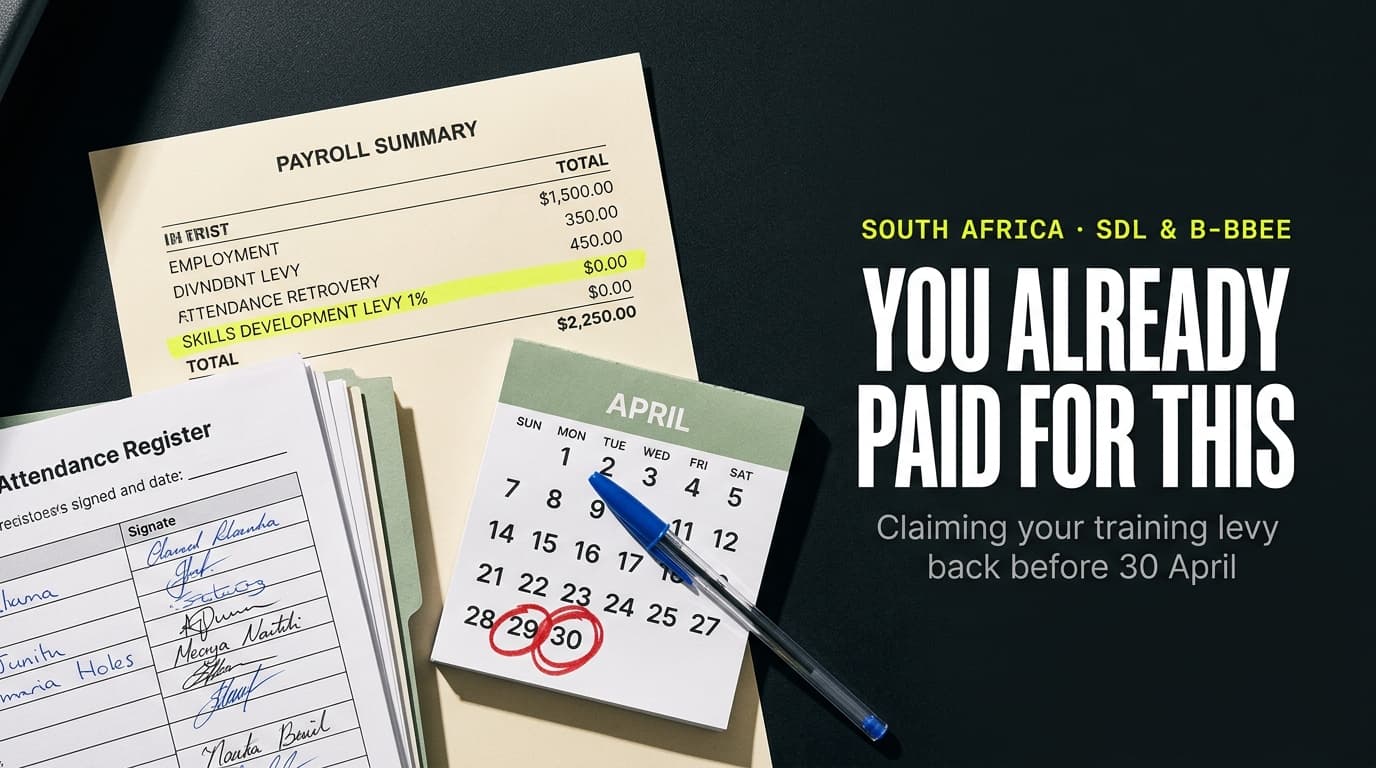
Training management software gives South African businesses one place to assign, deliver and prove staff training. For most SMEs it costs roughly R65 to R130 per user per month, or R2,400 to R8,000 a month on a flat plan. Its real return is not the courses — it is the evidence trail that unlocks SETA mandatory grants and B-BBEE skills development points.
Most South African businesses already pay for training. They pay the Skills Development Levy every month, they send people on courses, and they run inductions. What they usually cannot do is produce, in ten minutes, a defensible record of who was trained on what, when, and at what cost.
That gap is expensive. It is also entirely a software problem.
What is training management software, and how is it different from an LMS?
A learning management system (LMS) is the delivery engine. It hosts course content, runs learners through modules, scores assessments and issues certificates. Think of it as the classroom.
Training management software is the register. It tracks who is due for what, logs external and internal training, stores spend against each intervention, records competencies and expiry dates, and produces the reports your skills development facilitator and B-BBEE verification agency will ask for. Think of it as the school office.
Small vendors blur the two. Large vendors sell them separately. The practical question is not which label you buy — it is which of the two jobs is actually costing you money right now. If your problem is "our induction content is inconsistent," you need delivery. If your problem is "we cannot prove what we spent on training last year," you need the register.
Most South African SMEs have the second problem.
Do South African businesses legally need training software?
No. There is no law that requires you to run a specific system. But three obligations make a system the cheapest way to stay compliant.
The Skills Development Levy. If your total leviable payroll over the next twelve months will exceed R500,000, you are liable for SDL at 1% of payroll, paid monthly to SARS via your EMP201. Employers below that threshold are exempt and do not need to register. Once you are paying, that money is already gone — the only question is how much of it comes back.
The WSP and ATR. Each of South Africa's 21 SETAs requires levy-paying employers to submit a Workplace Skills Plan (what you intend to train) and an Annual Training Report (what you actually trained) by 30 April each year. Submit on time and you can claim the mandatory grant, calculated at 20% of your SDL contribution. Miss the deadline and you forfeit it. There is no partial credit and no appeal for lateness.
B-BBEE skills development. Under the Codes of Good Practice, skills development is a priority element worth up to 20 points plus bonus points on the generic scorecard. Large generic enterprises target skills spend at 6% of payroll on black employees; qualifying small enterprises target 3%. Miss the 40% sub-minimum on a priority element and your entire scorecard is discounted by one level — across all five elements, regardless of how well you scored elsewhere.
None of these require software. All of them require records. The difference between a business that claims its grant and one that does not is almost never budget — it is whether someone can find the attendance registers in April.
Worth knowing: grant percentages and scorecard targets are periodically revised. Confirm the current figures with your SETA and your verification agency before you build a business case on them.
How much does a learning management system cost in South Africa?
Most platforms sold into South Africa are priced in US dollars, so your invoice moves with the rand. At roughly R16.10 to the dollar in early September 2026, the market looks like this.
| Tier | Typical model | Indicative monthly cost (ZAR) | Best for |
|---|---|---|---|
| Open source (self-hosted) | Free licence, you pay hosting and admin | R0 licence + 0.25–1.0 FTE of internal time | Businesses with real in-house IT capacity |
| SMB cloud LMS | Per active user | ~R65–R130 per user / month | 20–150 learners, standard course delivery |
| SMB cloud LMS | Flat tiered plan | ~R2,400–R8,000 / month | Predictable headcount, capped user bands |
| Enterprise LMS | Custom quote, active-user models | Published averages sit near R400,000 / year at ~200 learners | Multi-site, multi-language, deep integrations |
| Training module inside a business platform | Included in platform subscription | Marginal | Businesses that need the register more than the classroom |
| Custom build | Fixed-scope project | Quoted per scope | Regulated workflows nothing off-the-shelf handles |
Two cost traps are worth naming plainly.
The first is active-user billing. Several vendors charge for users who log in during a billing period, not for licences you hold. That is generous when training is seasonal and brutal when you onboard forty people in March. Read the definition before you sign.
The second is free. Open-source platforms carry no licence fee, but published estimates put realistic self-hosting at between a quarter and a whole full-time role once you account for upgrades, security patching and support. If nobody on your team owns that, "free" becomes an unmaintained system holding your compliance evidence.
All figures above are indicative ranges affected by exchange rates, user counts and contract terms. Book a scoping call and we will give you a fixed quote against your actual headcount.
LMS, platform module, or custom build: how do you choose?
| Standalone LMS | Register inside a business platform | Custom build | |
|---|---|---|---|
| Time to first use | Days | Days | Weeks to months |
| Course authoring depth | Strong | Basic to moderate | Built to spec |
| Links training to payroll, roles and cost centres | Usually via integration | Native | Native |
| WSP/ATR and B-BBEE reporting | Often manual export | Built into reporting | Built to spec |
| Ongoing cost | Per user, indefinitely | Included in platform fee | Maintenance only |
| You own the system | No | No | Yes |
The decision rule is simpler than the table suggests.
Buy an LMS when content delivery is the job — you have real courses, real assessments, and learners who need a structured path through them.
Keep the register inside a platform you already run when the job is tracking. Skills spend is a cost like any other, and it is far easier to report on when it sits beside your cost centres and financial data instead of in a separate tool that has to be reconciled. This is the logic behind Business OS: operations, finance and support data feed one executive dashboard, so year-end reporting becomes a filter rather than a project. The same principle applies to training records wherever you hold them.
Build custom only when a regulated or unusual workflow has no viable off-the-shelf equivalent — safety competencies tied to equipment certification, franchise-wide accreditation with variable curricula per region, or training that must gate access to something operational. That is the territory our custom software team works in.
If you are somewhere in between, start with the register and add delivery later. Reversing that order is how businesses end up with a beautiful course library and no idea what they spent.
What features actually matter for a South African SME?
Ignore the feature grid. Six things determine whether the system earns its subscription.
- Per-employee training history with spend. Course, date, provider, cost, NQF level where applicable. This is the raw material for both the ATR and your skills development spend calculation.
- External training capture. Most SME training happens off-platform — a supplier course, a conference, a half-day with a consultant. If logging those takes more than a minute, nobody will.
- Expiry and renewal tracking. First aid, forklift, health and safety, professional registrations. The system should tell you what lapses in sixty days without being asked.
- Demographic fields. B-BBEE reporting is disaggregated. If the system cannot report skills spend by race, gender and disability status, you will rebuild every report by hand in a spreadsheet.
- Export that matches the submission. Your SETA has a template. A system that exports its own format and nothing else has moved the work, not removed it.
- POPIA-appropriate handling. Training records are personal information, and health-related competencies edge into special personal information. Data residency, access control and retention rules are not optional extras. Our approach is set out in our POPIA commitment.
Everything else — gamification, social learning, AI course generation — is upside. These six are the floor.
How long does a rollout take?
Faster than most people fear, if you sequence it correctly.
Weeks 1–2: load the register. Employees, roles, cost centres, and the last two years of training history. This is the unglamorous part and the part that creates immediate value, because it is the first time the picture exists in one place.
Weeks 3–4: set the rules. Required training per role, renewal intervals, approval workflow for spend.
Month 2 onwards: add delivery. Move your induction and your most-repeated internal course into the system. Leave specialist external training external.
Businesses that try to author their entire course library before going live typically stall in month three. The register works from day one; the classroom can be built as you go.
Time your kickoff against 30 April. A system loaded in September has a full cycle of clean data behind it by the next submission window. A system loaded in March has a panic.
The honest summary
Training software will not make your people better at their jobs. Good training does that. What software does is make the training you already pay for visible, provable and claimable — turning a levy you cannot avoid into a grant you can collect and scorecard points you can bank.
For most South African SMEs, that means the training register belongs in the same system as payroll, cost centres and reporting rather than in a separate platform that has to be reconciled every April.
If you would like to see what that looks like against your actual headcount and levy, book a no-obligation discovery call. We will map your current training records, show you where the reporting gaps are, and tell you honestly whether you need a platform module, an LMS, or nothing at all. You can also review Business OS pricing first.
Frequently asked questions
What is training management software? Training management software is a system that records who has been trained on what, when, by whom and at what cost. It differs from a learning management system, which focuses on delivering and assessing course content. Many South African businesses need the record-keeping more urgently than the delivery.
Do I have to pay the Skills Development Levy? If your total leviable payroll over the next twelve months will exceed R500,000, yes — SDL is 1% of payroll, declared monthly to SARS on your EMP201. Employers below that threshold are exempt and are not required to register for SDL.
How much of my Skills Development Levy can I claim back? Levy-paying employers who submit a Workplace Skills Plan and Annual Training Report to their SETA by 30 April each year can claim the mandatory grant, calculated at 20% of their SDL contribution. Missing the deadline forfeits the grant for that cycle. Confirm the current percentage with your SETA.
Does training software improve my B-BBEE score? Indirectly but significantly. Skills development is a priority element worth up to 20 points plus bonus points, with spend targets of 6% of payroll for large generic enterprises and 3% for qualifying small enterprises. Software does not create spend — it produces the disaggregated evidence a verification agency needs to award the points you have already earned.
Should I buy an LMS or build custom training software? Buy when you need course delivery and your requirements are standard. Use the training module in a business platform you already run when your real need is tracking and reporting. Build custom only when a regulated or operationally unusual workflow has no viable off-the-shelf equivalent.
How much does a learning management system cost in South Africa? Indicative ranges are roughly R65 to R130 per active user per month, or R2,400 to R8,000 a month on flat SMB plans, with enterprise platforms quoted individually. Because most vendors price in US dollars, your rand cost moves with the exchange rate. Book a scoping call for a fixed quote.
This article summarises publicly available SARS, SETA and B-BBEE Codes of Good Practice guidance as at September 2026, with US dollar pricing converted at roughly R16.10. It is not legal, tax or B-BBEE advice — Syniq is a software company. Confirm current levy rates, grant percentages and scorecard targets with your SETA, your accountant and your verification agency.